

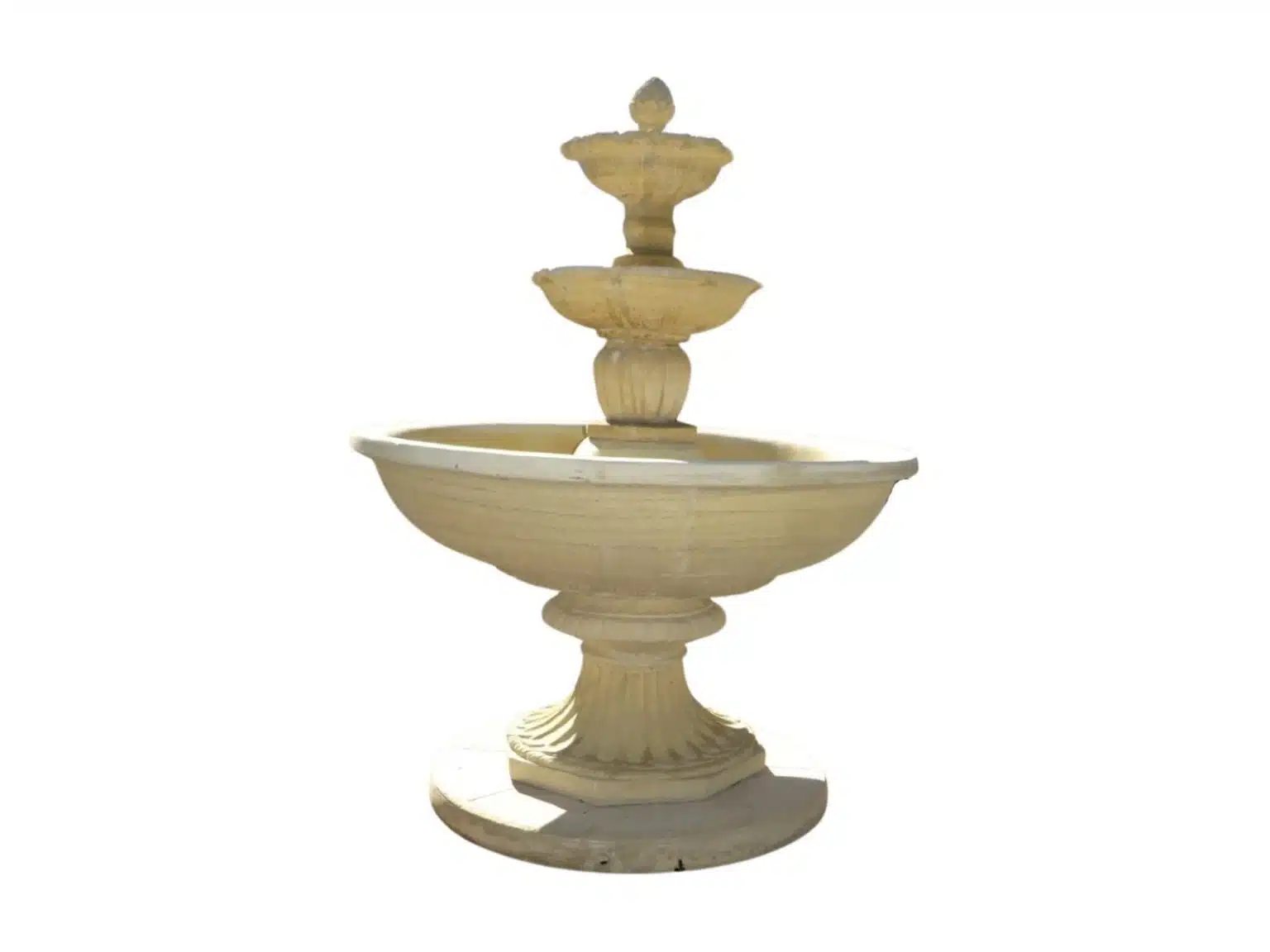
A tiered fountain is the classic centerpiece for a courtyard, garden or estate entry. The main choices are height, the number of tiers and the material, such as cast stone or marble, and each one needs a level base, a safe power supply and a plan for winter. Our floor shows the range, from a two-tier Belgian fountain with lion heads to a four-tier Antwerp fountain.
A short history of the garden fountain
Fountains have been a feature of landscape design since ancient times, Britannica notes. They fell out of favor in the medieval period, when the well was more common, returned in the late Middle Ages, and reached their greatest prominence in the Renaissance and Baroque periods, when sculpture became central to the design, as at Rome’s Trevi Fountain.
That sculptural tradition carries through to the pieces on our floor: lion heads and fleur-de-lis on a Belgian two-tier fountain, a mythological wind face on a wall fountain, and a biblical scene on a figural fountain.
Cast stone or marble?
- Cast stone is defined by the Cast Stone Institute as a refined architectural concrete manufactured to simulate natural cut stone, made from white or grey cement, sand, crushed stone or gravel and mineral pigments. Its fine-grain texture lets it replicate intricate carved stone. Like other concrete, it expands and contracts with changes in temperature and moisture.
- Marble is natural stone, carved rather than cast, with its own color and veining, like our three-tier rose marble fountain. The U.S. Geological Survey explains that acids in polluted rain react with the calcite in marble, which over time roughens exposed surfaces and softens carved detail.
Neither material likes water freezing on or in it, which is why winter care, covered below, matters for both.
How tall a fountain do you need?
- Three-tier Belgian cast stone fountain (BY1316): 80″ H × 63″ diameter.
- Four-tier Antwerp fountain with fluted base (BY1320): 96″ high.
- Three-tier rose marble fountain (RY1): carved in rose marble, 100″ high.
- Belgian two-tier cast stone fountain with lion heads and fleur-de-lis (BY1301): 103″ H × 57″ W.
Scale the fountain to the space around it and to the house behind it. A broad courtyard or a long view down a drive can carry one of the tall tiered pieces; a tighter garden or a terrace wall may suit a figural fountain such as Rebecca at the Well or a wall fountain with a wind face. Mark the footprint and height on site before you decide, and ask us for any dimension not listed here.
Rebecca at the Well and the wind face
Rebecca at the Well comes from Genesis 24. Abraham sends his servant to find a wife for his son Isaac; the servant stops at a well near evening and prays that the right woman will give him a drink and offer to water his camels too. Rebekah arrives with her water jar and does both. Our cast stone fountain (BY1371) takes that scene as its subject.
The wind face draws on classical myth. Greek and Roman writers personified the winds, with Boreas the north wind, Notus the south, Eurus the east and Zephyrus the west, and Aeolus as their keeper; in Homer’s Odyssey he gives Odysseus a bag holding the unfavorable winds. Old printed world maps, such as a Latin edition of Sebastian Münster’s, ring the globe with the heads of wind gods blowing toward the earth. Our substantial cast stone wall fountain (BY1817) carries the mask of a mythological wind face and measures 52″ H × 43″ W × 27.5″ D.
Setting it up: pump, power and a level base
Kansas State University Research and Extension describes the basic system of a small garden fountain: water is pumped from a basin up through the fountain and drains back down, so it recirculates rather than running from a water line. The same guidance calls for a GFCI-protected outlet near the basin and a level basin so the fountain sits level.
- Power: codes often require GFCI protection for outdoor pump outlets, a weatherproof cover keeps the outlet usable in wet conditions, and an electrician should make the connection at the panel. Some municipalities require a permit.
- Foundation: set a large stone fountain on a firm, level pad, and have a mason or landscape contractor plan the placement.
- Access: plan a way to reach the pump; extension guidance suggests making it removable for cleaning and winter storage.
Winterizing a fountain in north Georgia
University of Georgia Extension notes that only the top two inches of ground freeze in most of Georgia, but exposed water still freezes and expands. For a fountain, the danger is water left standing in the bowls: Oregon State University Extension warns that water freezing on concrete can make the surface shale and crack.
- Drain the basins and don’t let the fountain sit in a pool of ice.
- Remove the pump and store it indoors.
- If the bowls can’t be turned over, fill them with absorbent material and cover the fountain with heavy-duty plastic anchored with twine.
- For marble, choose the cover carefully: English Heritage research found that some covers kept statues wetter than leaving them bare, and that a breathable, insulated close-wrap gave the best protection against surface wetness.
Pair a fountain with statuary from our guide to entry eagles, lions and garden statuary.
Frequently asked questions
What is the tallest fountain on the floor?
The Belgian two-tier cast stone fountain with lion heads (BY1301), at 103 inches.
What is cast stone?
Cast stone is a refined architectural concrete made to simulate natural cut stone, using cement, sand, crushed stone or gravel and mineral pigments. It can reproduce intricate carved detail.
Does a garden fountain need a water line?
Usually not. A garden fountain recirculates water pumped from its basin, so the essentials are a level base and a GFCI-protected outdoor outlet.
How do I protect a stone fountain in winter?
Drain the bowls, remove and store the pump indoors, and cover the fountain so water cannot collect and freeze in it. Freezing water can crack a stone or concrete bowl.
Is marble or cast stone better outdoors?
Both are used outdoors, and both need water kept out of the bowls in a freeze. Marble is natural stone whose calcite is slowly etched by acid rain; cast stone is a concrete made to look like cut stone.
What is the story of Rebecca at the Well?
In Genesis 24, Abraham’s servant, sent to find a wife for Isaac, waits at a well and prays for a woman who will give him water and water his camels. Rebekah does both.
Where can I see them all?
Browse Fountains.
See it in Roswell
Every piece in this story is on the floor at the Red Baron Antiques showroom, 872 Atlanta Street, Roswell, Georgia, open Monday through Friday from 9 am to 5 pm. Call (770) 640-4604 or email [email protected] with the item number, and the team will tell you more.