

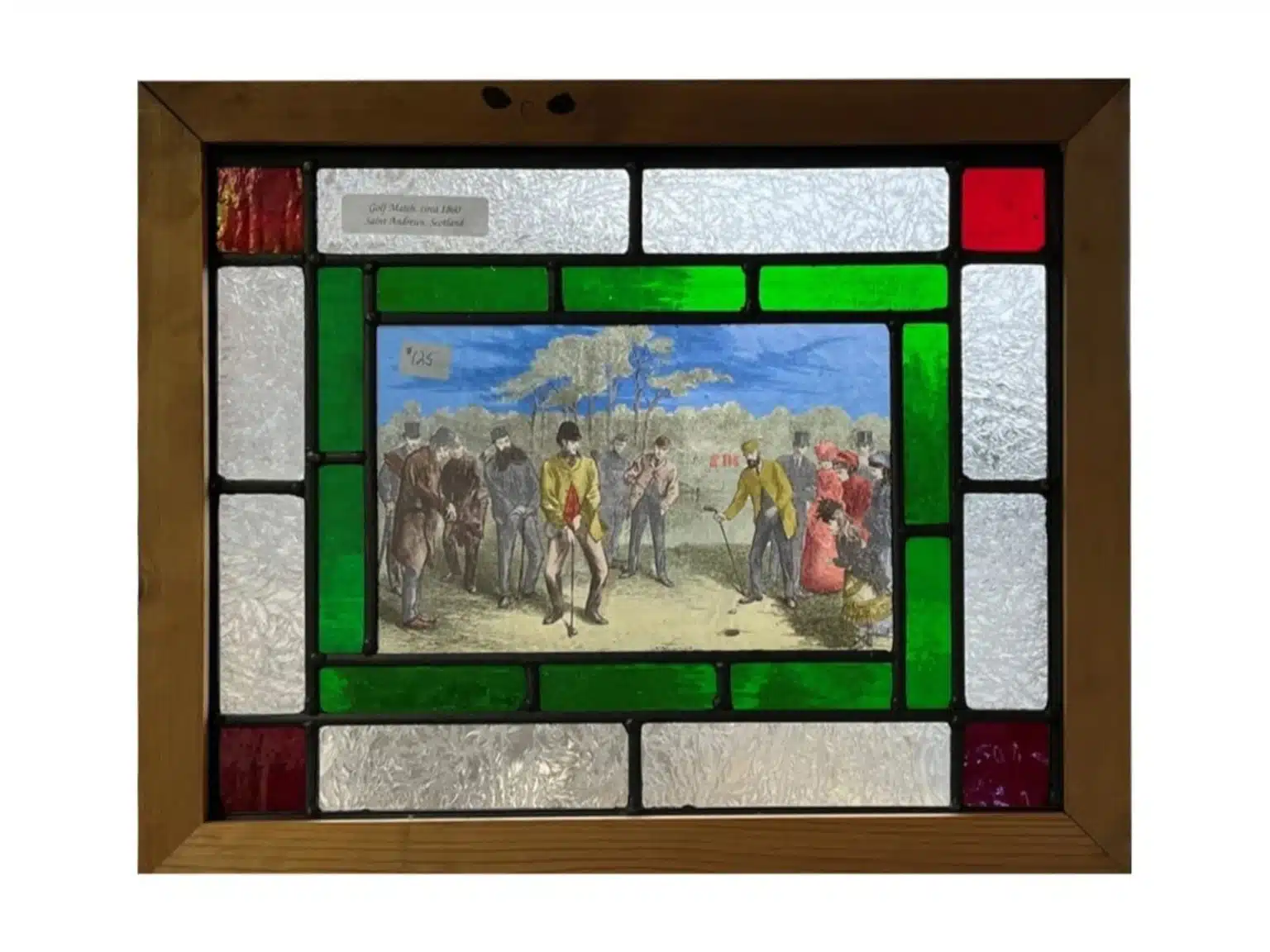
English stained glass windows with sporting scenes put golf and angling into the glass of a study, a clubhouse or a home bar. Our floor has a group of them, led by a window of gentlemen golfers at St Andrews, circa 1880, with three angling windows and an English triple-scene panel. All of them are small enough to set into an interior window, a cabinet door or a lightbox.
How is a stained glass window made?
In a traditional stained glass window, each piece of coloured glass is fitted into H-shaped strips of lead called cames, according to the Victoria and Albert Museum. The maker then rubs putty into the spaces between glass and lead to make the panel weathertight.
Faces, foliage and fine detail are painted on with vitreous paint, a mix of metal oxide, ground glass and a binder that has to be fired in a kiln to fuse it to the glass. A later technique, silver stain, came into use in the 14th century: it is applied to the back of the glass and burns into the surface when fired.
Why Victorian houses had stained glass
At the start of the 19th century, the V&A notes, stained glass was effectively a dead art. Gothic Revival architects and designers relearned its methods, and a great wave of new churches filled with large, colourful windows. The 1850s saw a major revival in stained glass manufacture.
The craft then moved into the home. The V&A credits Morris, Marshall, Faulkner & Co. with helping reintroduce stained glass into domestic design, and observes that decorated windows had become increasingly secular over time. Sporting scenes belong to that secular, domestic side of the story.
Why is St Andrews called the home of golf?
St Andrews, on the coast of Fife in Scotland, is home to the Royal and Ancient Golf Club, founded on 14 May 1754 as the Society of St Andrews Golfers by 22 noblemen and gentlemen. It took its present name in 1834 with the permission of King William IV, and in the late 19th century became the authority on the rules of the game in Britain and the Commonwealth. The club itself lists keeping St Andrews’ position as “the home of golf” among its objectives.
The Old Course gave the game its shape: Britannica notes it was played nine holes out and nine holes back, the pattern that became the standard 18-hole round. The Open was first held at St Andrews in 1873. Our window (RG380) shows gentlemen golfers at St Andrews, circa 1880, and suits a clubhouse, a golfer’s study or a home bar.
Angling in English life
Fishing has a long literary pedigree in England. Izaak Walton’s The Compleat Angler; or, the Contemplative Man’s Recreation was first published in 1653, and Walton kept expanding it through 1676. Britannica counts it among the most reprinted titles in English literature.
By the Victorian era the Thames had its own angling institutions. The Thames Angling Preservation Society was formed in the late 1830s, and as the railways spread, cheap Sunday fares let working Londoners reach cleaner waters outside the city. The London Anglers Association, formed in 1884, grew to more than 40,000 members at its peak.
On our floor
- St Andrews golfers window, circa 1880 (RG380): gentlemen golfers at St Andrews, Scotland; 15″ H × 18.5″ W.
- English fly fishing window, circa 1880 (RG381): Englishmen fly fishing in a stream; 16″ H × 19.5″ W.
- Englishmen fishing in a boat (RG382): three 19th-century Englishmen fishing from a boat; 19″ H × 22″ W. Ask us about the date of the window itself.
- Fishing on the Thames double scene cottage window (RG312): an English cottage window with two scenes of fishing on the Thames; 24″ H × 10″ W, a tall, narrow format.
Alongside the sporting windows is a triple scene English stained glass window (RG375), three scenes across a panel 13″ H × 30″ W. Its long, low shape suits a transom or the space above a back bar; call us for a description of the scenes.
How to display small stained glass
Stained glass needs light behind it. A few ways to give it that:
- Set the panel into an interior window or transom between two rooms.
- Fit it into a cabinet or bar door.
- Hang it in front of a sunny window.
- Mount it in a lightbox so it glows at night.
Measure the opening before you fall in love with a panel, and allow for the frame or channel that will hold it. For more decorated glass for a bar, see our guide to reverse-on-glass pub mirrors.
Condition and care of old leaded glass
Not every flaw in an old window calls for repair. Guidance from the Minnesota Historical Society says minor cracks, sagging and oxidation are not, by themselves, signs that repair is needed. Significant glass breakage, cracked lead cames or solder joints, and visible daylight between glass and lead do indicate that treatment is required.
Clean gently, starting with the least aggressive method, and never use acidic, caustic, abrasive or ammonia-containing cleaners. Total releading should be done only when necessary, so take a panel that needs structural work to a stained glass conservator rather than flattening it yourself.
Frequently asked questions
How old are these windows?
The St Andrews golfers window (RG380) and the fly fishing window (RG381) date to about 1880. The boat window (RG382) shows a 19th-century scene; ask us about the dates of the others.
How is a traditional stained glass window made?
Pieces of coloured glass are held in H-shaped lead strips called cames and sealed with putty. Painted detail is done in vitreous paint, which is fired in a kiln to fuse it to the glass.
Why is St Andrews called the home of golf?
St Andrews is home to the Royal and Ancient Golf Club, founded in 1754, which became the authority on the rules of golf. Its Old Course set the pattern for the standard 18-hole round.
How do I display a small stained glass panel?
Give it light from behind: set it into an interior window or cabinet door, hang it in front of a sunny window, or mount it in a lightbox for evening viewing.
Is a hairline crack or slight sag a problem?
Not necessarily. Historic preservation guidance treats minor cracks, sagging and oxidation as normal age; significant breakage, cracked cames or daylight between glass and lead are the signs that repair is needed.
How should I clean old stained glass?
Start with the gentlest method and avoid acidic, caustic, abrasive or ammonia-containing cleaners. Leave structural repairs to a stained glass conservator.
Where can I see all of the stained glass?
Browse Stained Glass & Windows.
See it in Roswell
Every piece in this story is on the floor at the Red Baron Antiques showroom, 872 Atlanta Street, Roswell, Georgia, open Monday through Friday from 9 am to 5 pm. Call (770) 640-4604 or email [email protected] with the item number, and the team will tell you more.