

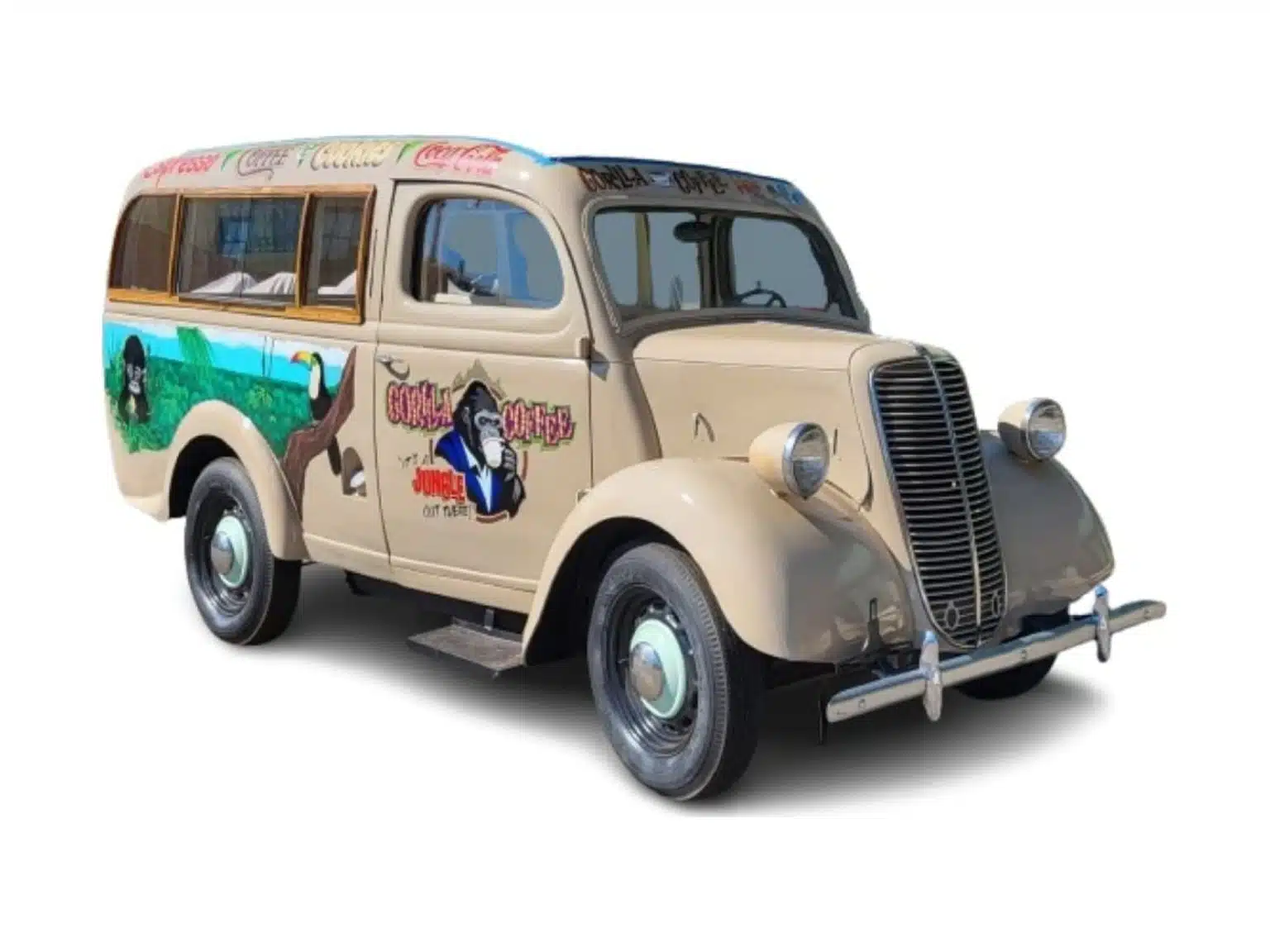
The Ford E83W was Ford of Britain’s 10 hundredweight (half-ton) light commercial, built at Ford’s Dagenham plant in East London from 1938 to 1957. Bodied as vans, pickups and specialist builds such as mobile canteens and ice cream vans, it was a working vehicle through and through. Our restored 1947 E83W vending truck carries that working history into a collection, a business or a show.
What is the Ford E83W?
The E83W was Ford of Britain’s half-ton van, the bigger brother to the company’s 5 cwt vans. It was aimed at small hauliers, tradesmen and merchants, where it sold well, and its main rival was the Bedford range built by General Motors’ British commercial arm.
Production ran for 19 years at Dagenham, carrying on through the Second World War. Early vans were sold as Fordsons; from 1952 the E83W was also sold under the Thames name, the brand Ford of Britain used for its commercial vehicles until it dropped the name in 1965.
What does 10 cwt mean?
“Cwt” is the abbreviation for hundredweight. The British, or long, hundredweight is 112 pounds, and 20 of them make a long ton of 2,240 pounds. A 10 cwt rating therefore means a payload of 1,120 pounds, or half a long ton, which is why the E83W is often called a half-ton van.
The E83W in brief
- Built: 1938 to 1957 at Dagenham, England.
- Rating: 10 cwt, or half a ton.
- Engine: Ford’s 1,172 cc side-valve four-cylinder, rated at 30 brake horsepower.
- Gearbox: three-speed manual.
- Layout: semi-forward control, with the engine offset to one side, which gave the driver more legroom and the passenger less.
- Running gear: thermosyphon cooling and drum brakes all round.
- Bodies: panel van, pickup and estate, plus specialist builds including mobile canteens, ice cream vans and fire pumps.
- Names: Fordson E83W, and from 1952 also Thames.
Why is the E83W so slow?
The E83W was geared for work, not speed. Its rear axle was heavily geared down for pulling power, which made the van much slower than Ford’s saloon cars and kept its effective top speed not much over 40 mph. One British auction house sums up the type as “simple, slow and sturdy,” and notes that these vans tended to lead hard lives.
For a buyer today, that gearing is worth understanding. These trucks were built for short trips at an unhurried pace, so plan any outing around that rather than around highway travel.
Where did E83Ws go?
After the Second World War, Britain needed exports, and the E83W was sold in various forms around much of the world. In some countries only the cowl and chassis were imported, and local firms built the bodies. A 1952 E83W pickup built at Ford’s Lower Hutt plant in New Zealand, for example, has an all-steel cargo bed rather than the wooden drop sides used on British pickups. The grille was designed to suit either right- or left-hand drive, and both were built.
At home, E83Ws did the everyday jobs of a working economy. A 1955 E83W Thames 10 cwt van in the collection of the Grampian Transport Museum in Scotland spent its working life carrying beef around Aberdeenshire.
Our truck: RV136
Our 1947 English Ford E83W vending truck (RV136) is a rare E83W vending truck. It has been beautifully restored, with a restored engine and new tires, and it has the E83W’s three-speed gearbox. A 1947 build places it in the years just after the war, when Britain was seeking exports.
As a vending truck, it shares its purpose with the mobile canteens and ice cream vans built on the E83W chassis, and it makes a striking centerpiece for a business, a collection or a showroom.
Owning a vintage E83W
- Find the club. The Ford Sidevalve Owners’ Club in Britain, formed in 1969, covers Fords built in the UK from 1932 to 1962 and lists the E83W among the commercial vehicles it supports. Its members-only spares scheme offers secondhand engines, axles, gearboxes and body panels as well as new gaskets, bearings and brake parts.
- Find the right mechanic. Have someone familiar with vintage side-valve Fords inspect the truck before you plan to use it.
- Plan for its pace. With a top speed not much over 40 mph, think about how the truck will get to an event as well as how it will look once it is there.
- Ask about paperwork. Ask the showroom what documents come with the truck, and check title and registration questions with your state’s motor vehicle agency.
See more pieces from the road in Automobilia & Petroliana, and read about another branch of vending history in our guide to vintage Coca-Cola machines from Cavalier and Mills.
Frequently asked questions
Is the E83W a car or a truck?
It is a light commercial vehicle: the chassis was built for vans, pickups and specialist bodies such as mobile canteens and ice cream vans.
Where was it built?
At Ford’s Dagenham assembly plant in East London. In some export markets, local firms built bodies on imported chassis.
What engine does the Ford E83W have?
Ford’s 1,172 cc side-valve four-cylinder, rated at 30 brake horsepower, driving through a three-speed gearbox.
How fast does an E83W go?
Not very fast. The rear axle was geared low for pulling power, which kept the effective top speed not much over 40 mph.
Why is it called a Fordson or a Thames?
Ford of Britain sold the E83W under the Fordson name, and from 1952 it was also sold under Thames, Ford’s British commercial vehicle brand.
Can I see the truck in person?
Yes, at our Roswell showroom. See more automotive pieces in Automobilia & Petroliana.
See it in Roswell
Every piece in this story is on the floor at the Red Baron Antiques showroom, 872 Atlanta Street, Roswell, Georgia, open Monday through Friday from 9 am to 5 pm. Call (770) 640-4604 or email [email protected] with the item number, and the team will tell you more.