

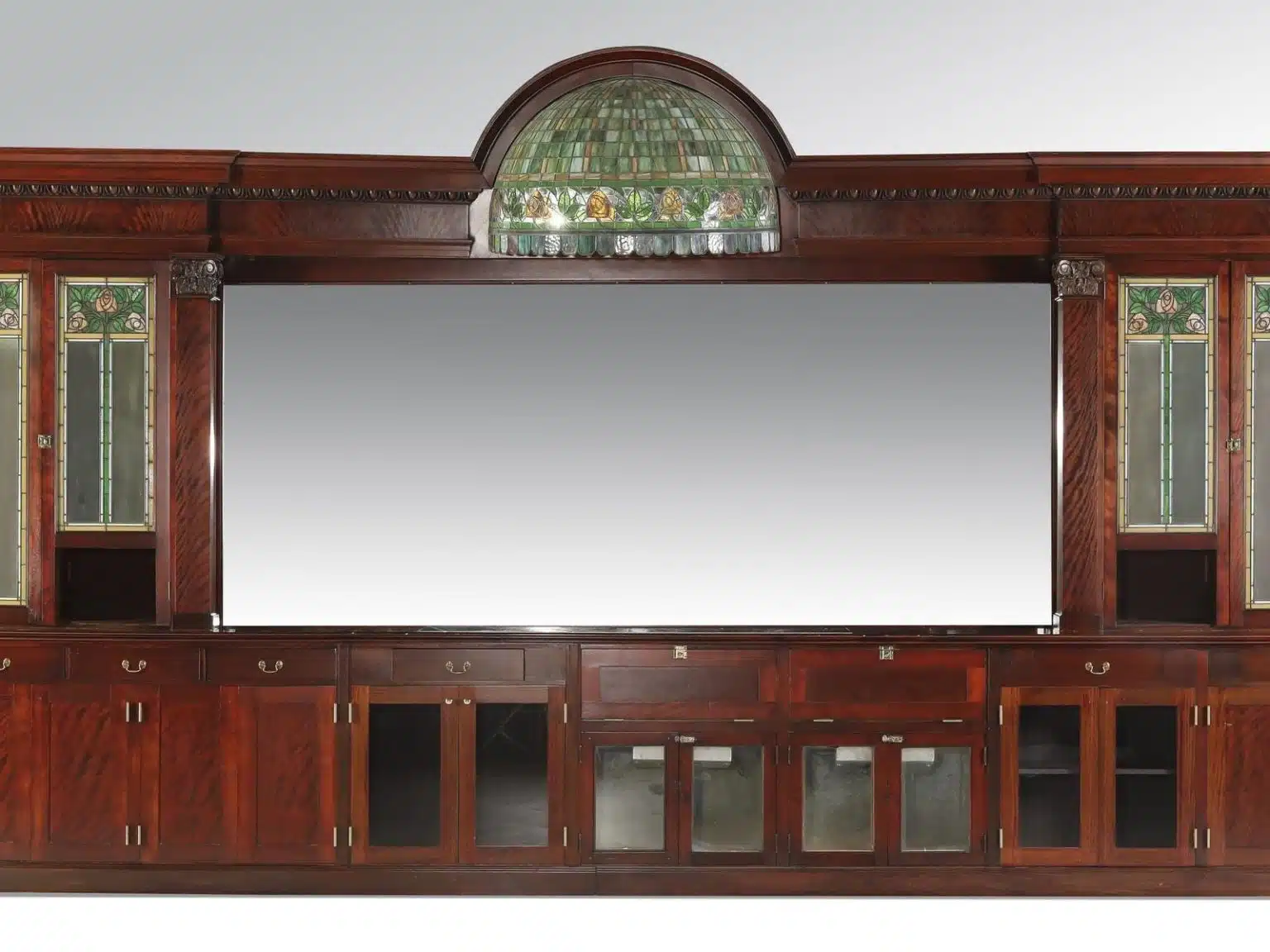
A Brunswick-Balke-Collender back bar is one of the most sought-after pieces in American bar collecting: a saloon fixture from the company best known for its billiard tables, built in rich woods with carved columns, large mirrors and, on the most elaborate examples, stained and leaded glass. Brunswick’s bar-fixture trade collapsed as the Prohibition movement spread, so the supply of original Brunswick bars is finite, and the best ones rarely come to market. Our 22-foot Brunswick-Balke-Collender mahogany back bar is one of them.
Who was Brunswick-Balke-Collender?
The company began with John Moses Brunswick, born in 1819 in Bremgarten, Switzerland. He emigrated to the United States at 14, and in 1845 he opened a carriage shop in Cincinnati, where he built his first billiard table the same year. The company’s own history credits him with the boast, “If it is wood, we can make it.”
The business grew by joining its rivals. In the 1870s Brunswick merged with Julius Balke’s Great Western Billiard Manufactory of Cincinnati to form J.M. Brunswick & Balke. In 1884 that firm merged with H.W. Collender of New York, successor to Phelan & Collender, creating the Brunswick-Balke-Collender Company. By the mid-1880s it was the world’s leading maker of billiard equipment, with a large plant in Chicago.
When did Brunswick make back bars?
Brunswick moved into bar fixtures in the late 1870s and 1880s, at first building them to special order. Its line included counters, sideboards, mirrors and beer coolers. The trade grew large enough that in 1891 the company opened a six-story building on East Sixth Street in downtown Cincinnati used only for selling bar fixtures.
The company’s history notes that the success of its back bar business led it into store display counters and church pews in 1903. In 1911 it built a bar-fixture plant in Dubuque, Iowa, billed as the “Largest Bar Fixture Factory in the World,” which made ornate front and back bars of rich woods, mirrors and stained glass and shipped them around the world.
How did Prohibition end the Brunswick bar?
By the company’s own account, bar fixtures made up nearly a quarter of its revenue when the Prohibition movement devastated that business around 1912. Brunswick put its idle capacity to work making rubber products, including tires and the Whale-Bone-Ite toilet seat, then piano cases and phonograph cabinets from 1915, its own phonographs from 1916 and, after that, records under the Brunswick label.
National Prohibition took effect on January 17, 1920, and lasted until the 21st Amendment repealed it on December 5, 1933. For collectors, the result is simple: the ornate Brunswick bars people seek today were built in the decades between the late 1870s and the Prohibition era.
What makes a Brunswick back bar desirable?
- Craftsmanship. Cabinetmaker joinery, carved columns and capitals, and figured hardwoods such as mahogany and oak that have aged to a deep patina.
- Scale and presence. Many were built to anchor a large room, with long mirrors and tall crowns that set the tone for the whole space.
- Glass. Large mirrors and, on the most elaborate examples, stained and leaded glass in canopies and cabinet doors.
- The name. For a restaurant, brewery or private club building an authentic period room, a documented Brunswick is the benchmark.
How to identify a Brunswick back bar
An attribution should rest on evidence in the bar itself, not on style alone. These are the clues worth checking:
- A maker’s plate. Some Brunswick bars carry a brass plate reading “Brunswick-Balke-Collender.” If there is one, ask whether it is original to the bar.
- Assembly numbers. The Brunswick bar in the College Inn Bar in Douglas, Wyoming, installed in 1906, has a coded number on each piece so local carpenters could fit it together. If a bar has numbered sections, ask whether the numbers run consistently across them.
- Catalog designs. Brunswick sold its bars as named models, such as the “Empire” and the “Los Angeles.” A bar that matches a documented catalog design is easier to attribute with confidence.
- Construction. Look at the quality of the carving, joinery and glass, and whether the sections, mirrors and crown read as one design.
An example on our floor: RA565
Our 22-foot Brunswick-Balke-Collender mahogany saloon back bar shows why these bars command attention. Its centerpiece is a semicircular domed canopy of stained and leaded glass, worked in a geometric design inside a floral border, flanked left and right by cabinets with matching stained glass paneled doors.
At roughly 22.5 feet wide and 12 feet high, it is a bar for a restaurant, brewery, private club or a large home bar with the wall and ceiling to match. The price is available on request.
For comparison, the same floor holds a 24-foot triple arch oak back bar by Charles Passow & Sons of Chicago (RA668), a 28-foot Rothchild back bar with marble columns (RA606) and a 16-foot Victorian mahogany back bar (RA525). Read more about the Passow bar in our story on Charles Passow & Sons.
What to ask before you buy a Brunswick back bar
- What supports the attribution? Ask what identifies the bar as Brunswick, such as a maker’s plate, assembly numbers or a design that matches the company’s catalogs.
- How original is it? Ask which parts are original, including mirrors, glass, hardware and finish, and what has been restored.
- Is it complete? Confirm every section, crown and cabinet is present.
- Will it fit? Measure your wall length, ceiling height and the path into the room before you fall in love. Our back bar buying guide walks through it.
Frequently asked questions
Are all antique back bars made by Brunswick?
No. Brunswick was one of several important makers. Our floor also includes a 24-foot triple arch oak back bar by Charles Passow & Sons of Chicago and a 28-foot Rothchild back bar with marble columns.
When was the Brunswick-Balke-Collender Company formed?
It was formed in 1884, when J.M. Brunswick & Balke merged with H.W. Collender of New York. The business itself dates to 1845, when John Moses Brunswick built his first billiard table in Cincinnati.
Why did Brunswick stop making saloon bars?
The Prohibition movement devastated its bar-fixture business around 1912, when bars had been nearly a quarter of company revenue. Brunswick turned to rubber products, phonographs and records instead.
How can I tell if a back bar is a real Brunswick?
Look for a maker’s plate, numbered sections and a design that matches Brunswick’s catalog models, and ask the seller what supports the attribution. A bar with several of these clues is far easier to attribute than one with none.
How big are antique back bars?
The back bars in our current inventory run from 16 feet to 28 feet long. Browse them all in Antique Back Bars.
Can I see a Brunswick back bar in person?
Yes. RA565 is on display at our Roswell, Georgia showroom.
See it in Roswell
Every piece mentioned here is on the floor at the Red Baron Antiques showroom, 872 Atlanta Street, Roswell, Georgia, Monday through Friday from 9 am to 5 pm. Call (770) 640-4604 or email [email protected] with the item number and your measurements, and we will talk through fit.