

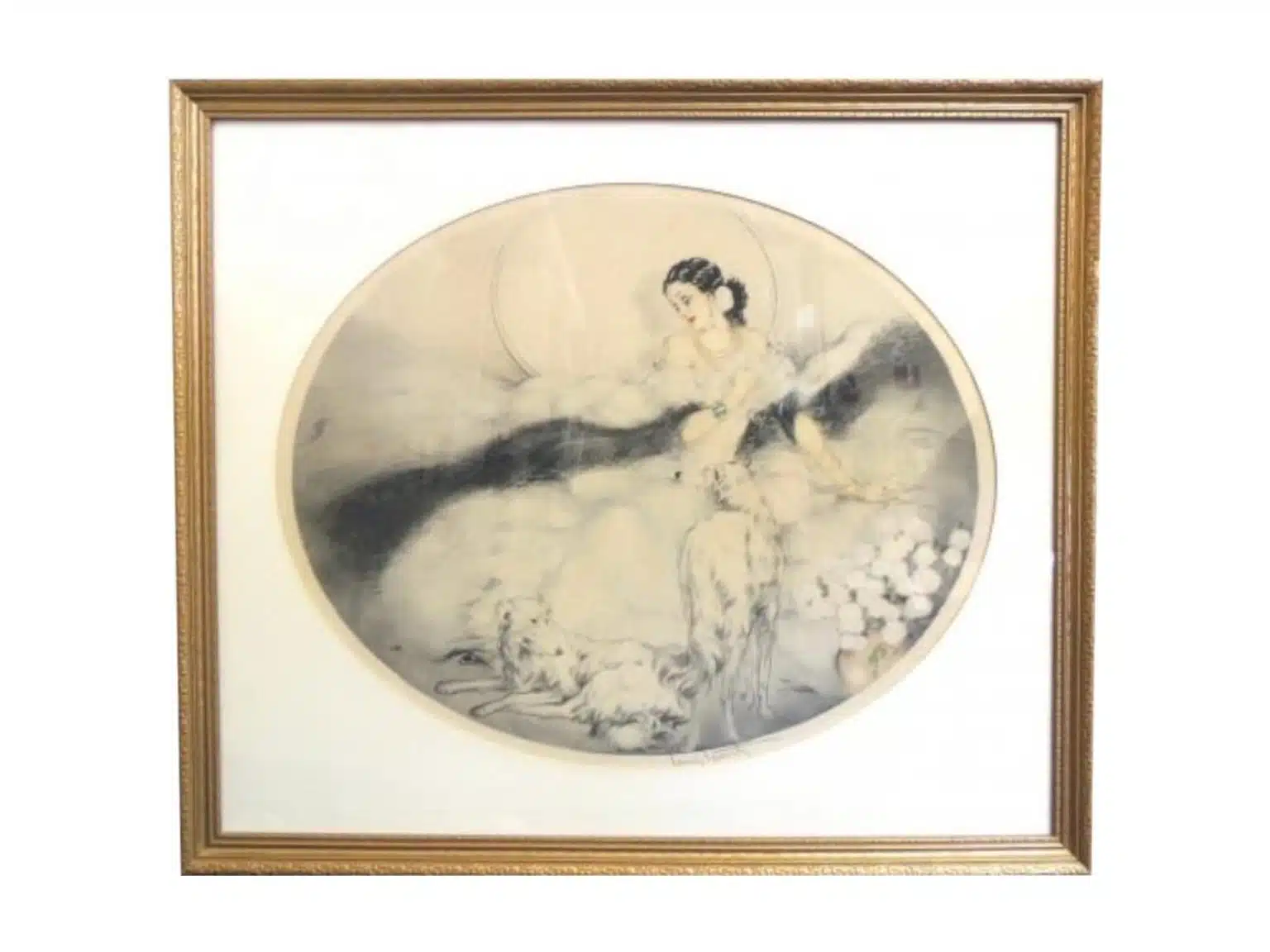
Louis Icart (1888–1950) was a French artist best known for his Art Deco etchings of elegant women, and “La Dame aux Camélias,” the Lady of the Camellias, is his image drawn from a famous 19th-century love story. The Fine Arts Museums of San Francisco catalogue an impression dated 1927 as a color etching, aquatint and drypoint. Red Baron has an original Icart “Lady of Camellias” on the floor, which our listing describes as an original drypoint etching.
Who was Louis Icart?
Icart was born in Toulouse in 1888 and died in Paris in 1950. He began in a postcard studio, then made title pages for the magazine La Critique Théâtrale and fashion sketches for fashion houses.
After showing at the Salon des Humoristes in 1913 he learned copperplate engraving. He served as a pilot in the First World War and made sketches and etchings on patriotic themes. After the war he worked mainly in aquatint and drypoint, often publishing one version of an image for the European market and another for the American market.
His first American exhibition opened in 1922 at the Belmaison gallery in John Wanamaker’s department store. His etchings became especially popular in the late 1920s, at the height of the Art Deco period.
The story behind the title
La Dame aux camélias is the 1848 novel by Alexandre Dumas fils (1824–1895), his first major success. It was based on his brief affair with the Parisian courtesan Marie Duplessis, and it tells the story of Marguerite Gautier and her young lover, Armand Duval, whose father persuades her to give him up.
Dumas adapted the novel for the stage, and the play opened in Paris on February 2, 1852, at the Théâtre du Vaudeville; in English it is often called Camille. Verdi’s opera La traviata, with a libretto by Francesco Maria Piave based on the play, premiered at La Fenice in Venice on March 6, 1853, with the heroine renamed Violetta Valéry.
Sarah Bernhardt became closely associated with the stage role, and in 1936 George Cukor directed Greta Garbo in the film Camille. Icart’s 1927 image belongs to that long line of retellings, carried into the fashion and mood of the 1920s.
When was Icart’s “La Dame aux Camélias” made?
The Fine Arts Museums of San Francisco hold a record for “La Dame aux Camelias (Lady of the Camelias)” by Louis Icart, dated 1927 and catalogued as color etching, aquatint and drypoint (accession number L12.34.12). That record describes the museum’s own impression. Our listing for RI16 does not state a date, edition, signature, size or condition, so ask the team about the specific sheet.
Drypoint and aquatint, explained
Both are intaglio techniques: the ink sits in lines or areas below the surface of a metal plate, and the pressure of printing leaves an indented border, called a plate mark, around the image.
- Drypoint: lines are scratched into the plate, raising a ridge of metal called burr. The burr holds ink and prints a soft, velvety line, but it wears down quickly as the plate is printed.
- Aquatint: the plate is coated with a powdered, acid-resistant resin and heated before etching, producing a grainy surface that prints areas of tone rather than line. Icart worked mainly in aquatint and drypoint, pairing areas of tone with line.
- Color: museum and auction records describe Icart sheets both as color etchings and as hand-colored drypoint etchings, so compare color carefully if you look at more than one impression.
How to tell an original Icart etching from a reproduction
Reproductions of Icart’s images exist, so it pays to look closely. These checks come from printmaking references and from Icart specialists.
- Look for a plate mark. An etching usually shows a pressed border around the image. Be aware that plate marks can be faked or trimmed away.
- Use a magnifier. A regular pattern of tiny dots points to a photomechanical process such as offset lithography, not an etching.
- Check the signature. Authentic Icart etchings are usually hand-signed in pencil, often at lower right; reproductions tend to carry a printed copy of the signature.
- Look for the windmill blindstamp. Icart’s raised windmill stamp, usually at lower left below the image, appears on many prints made from about mid-1926 onward. It is not proof on its own: some fakes carry false stamps, and some genuine Icarts have none.
- Ask questions. When in doubt, consult a specialist or qualified appraiser before you buy.
How to frame and display an etching
The Library of Congress’s preservation guidance for works on paper is a sound standard for any framed print.
- Use mat board made of 100 percent cotton rag or purified, lignin-free pulp, pH-neutral or slightly alkaline, at least 4-ply.
- Mount the sheet with photo corners or with hinges of Japanese tissue and wheat starch paste.
- Glaze with UV-filtering acrylic and keep the print from touching it.
- Hang on an interior wall, away from direct sun, fireplaces, radiators and vents.
- Limit light: long-term display is hard on paper, so consider rotating prints or covering the frame when the room is not in use.
On our floor
- RI16, Louis Icart “Lady of Camellias”: original drypoint etching by Louis Icart, titled “Lady of Camellias.”
For more French decorative art, see our story on hand-painted champagne advertising.
Frequently asked questions
When was “La Dame aux Camélias” made?
The Fine Arts Museums of San Francisco date Icart’s print to 1927 and catalogue it as a color etching, aquatint and drypoint.
Who was Louis Icart?
Louis Icart (1888–1950) was a French printmaker and painter, born in Toulouse, whose etchings of elegant women were especially popular in the late 1920s. He worked mainly in aquatint and drypoint.
What is “La Dame aux Camélias” about?
It is the 1848 novel by Alexandre Dumas fils about the Parisian courtesan Marguerite Gautier and her lover Armand Duval. It became an 1852 play and the basis of Verdi’s 1853 opera La traviata.
What is a drypoint etching?
A drypoint is a print made from a plate scratched directly with a needle, which raises a burr that prints a soft, velvety line. The burr wears down quickly during printing.
How can I tell if an Icart etching is original?
Look for a plate mark, a pencil signature and, on many later prints, a windmill blindstamp, and check under magnification for the dot pattern of a printed reproduction. No single sign is proof, so consult a specialist when in doubt.
Where else can I see art at Red Baron?
Browse Art & Prints.
See it in Roswell
Every piece in this story is on the floor at the Red Baron Antiques showroom, 872 Atlanta Street, Roswell, Georgia, open Monday through Friday from 9 am to 5 pm. Call (770) 640-4604 or email [email protected] with the item number, and the team will tell you more.