

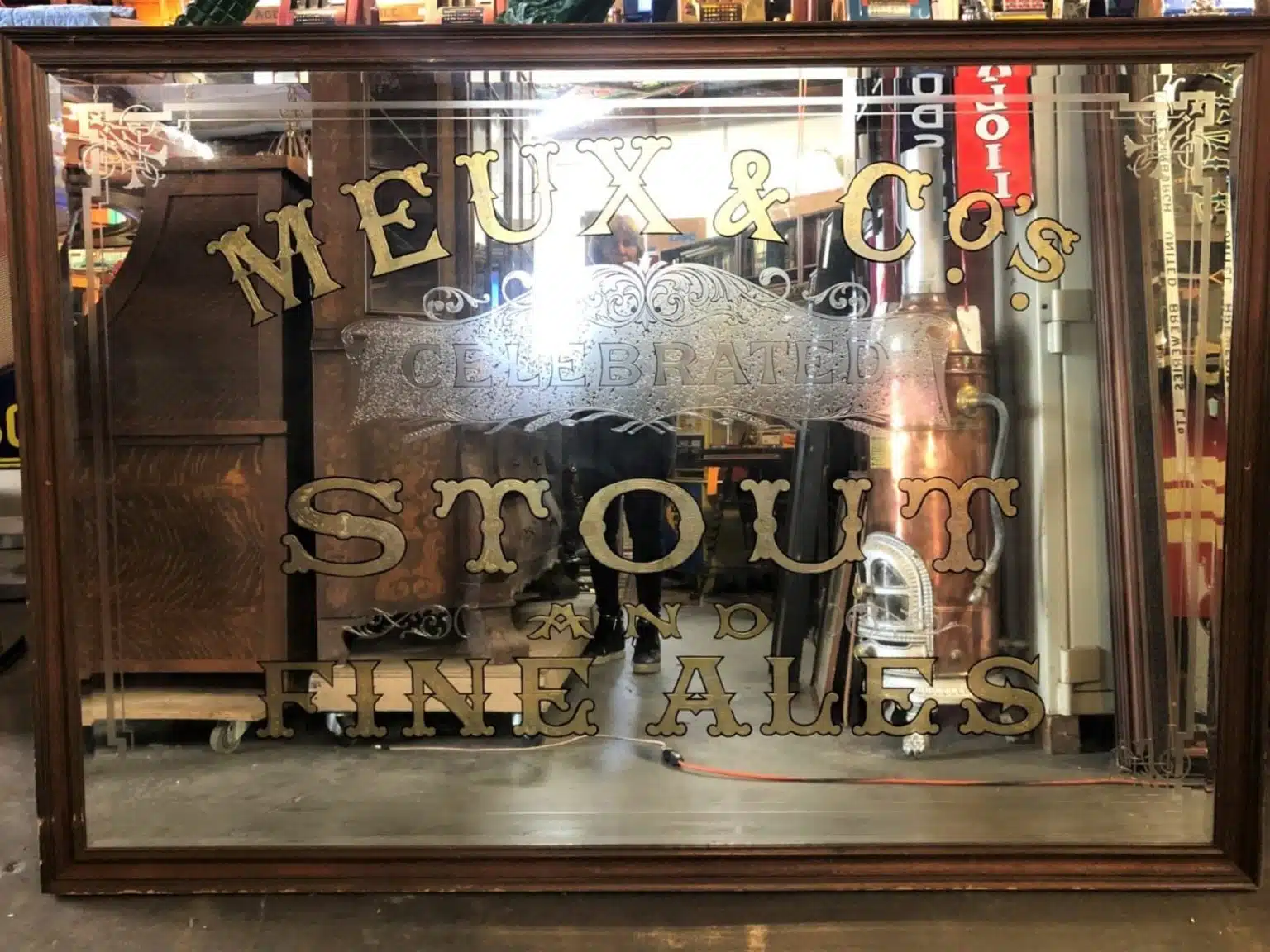
A reverse-on-glass pub mirror is a brewery or drinks advertisement painted on the back of a mirror, so the lettering reads correctly from the front. They were made to hang in British public houses, promoting the brewers and drink makers whose products were poured below them, and today they are some of the most decorative pieces you can hang over a bar. Our Roswell floor currently has four, from a large Meux & Sons stout mirror to a long Aitken’s Pale Ale mirror suited to the run of a back bar.
What does reverse-on-glass mean?
Reverse-on-glass describes decoration applied to the back face of a sheet of glass and seen through the front. Because the glass sits between you and the paint, the picture is built backwards: conservators describe the composition as beginning with the highlights and ending with the background, with no chance to paint over a mistake. The glass then acts somewhat like a varnish, protecting the paint and giving the color its depth and shine.
Verre églomisé
You will also see the French term verre églomisé, for gilding and decoration applied to the reverse of glass. It is named for Jean-Baptiste Glomy (d. 1786), a Paris picture framer who used it in his glass mounts, though the technique itself goes back to antiquity.
How brewery mirrors came to British pubs
The Victorians and Edwardians filled their pubs with decorative glass. The Campaign for Real Ale, which surveys historic pub interiors, notes that windows were etched and cut while interior glass could be embossed, enamelled or gilded, and that bar backs were often set with mirrors, some plain and some ornate. The later nineteenth century was the peak of pub building in Britain.
Lettered advertising mirrors grew out of that world. Beer historians Boak & Bailey trace back-painting, which brought color into pub glass, to the 1870s. They cite the architectural historian Mark Girouard, who dated branded pub mirrors to the 1890s, described them as paid for or subsidised by the breweries and distillers whose names they bore, and called them a speciality of the Brilliant Sign Company, established on Gray’s Inn Road in London in 1893.
The names on the glass
Pub mirrors carry the names of breweries, distillers and mineral water makers, and the history behind a name is part of the appeal.
Meux
Meux was a well-known London brewery. Its Horse Shoe Brewery stood at the junction of Tottenham Court Road and Oxford Street, and on 17 October 1814 a vat of porter burst there, flooding the crowded streets behind it and killing eight people. The firm was renamed Meux’s Brewery Company in 1878, moved brewing to Nine Elms in Wandsworth in 1921 and went into liquidation in 1961. The Dominion Theatre now stands on the old Tottenham Court Road site.
Aitken’s
James Aitken & Co. brewed at Falkirk in central Scotland. Archive records date the business to 1740, and by the 1820s it was run by brothers James and Lauchlan Aitken, grandsons of John Aitken, who had established the Falkirk Brewery. Its beers included several pale ales. The company was acquired in 1960, and brewing at Falkirk ended in 1966.
Hooper’s
Mineral water makers advertised alongside the brewers. We have not confirmed which Hooper firm our mirror names, so we describe it by what the glass says.
On our floor
- Meux & Sons stout (RC3247): a vintage beveled pub mirror painted in reverse on glass, 56 by 80 inches.
- Aitken’s Pale Ale (RC3249): a vintage reverse-on-glass pub mirror, a long 29 by 105 inches, suited to the run of a back bar.
- Hooper’s Mineral Waters (RC3254): a vintage English beveled pub mirror painted in reverse on glass, 45 by 51 inches.
- “Traditional Beers in Splendid Condition” (RC3251): a compact reverse-on-glass mirror, 16.5 by 54 inches.
What collectors look for
- Condition of the paint. Look from the front for flaking or losses in the reverse-painted areas. Conservators name paint lifting from the glass as the most common problem.
- The mirror silvering. Some age to the silvering is normal and adds character. Heavy loss in key areas affects appearance.
- The brand. Recognizable brewery names and good graphics draw the most interest.
- Size for the space. Long, narrow mirrors suit the space above a back bar. Squarer mirrors work as a focal point on a feature wall.
Original, later pastiche or modern copy?
Not every brewery mirror is Victorian. As old mirrors grew scarce, some brewers produced pastiches: Boak & Bailey suggest most of the familiar Tetley mirrors date from the 1970s or early 1980s, though many people assume they are far older. A later mirror can still look right over a bar, but it should be described for what it is.
- Check the name against the history. A brewery’s dates help place a mirror. Aitken’s stopped brewing at Falkirk in 1966, for example, while the Meux name carried on at Nine Elms into the 1960s.
- See it in person. Ask what is known about age and technique, and look at the piece before you decide.
How to care for a reverse-painted mirror
- Clean the front only. Put a little cleaner on a soft cloth rather than spraying a framed piece, since liquid can seep between the glass and the frame.
- Leave the back alone. Unfired paint and metal leaf are only weakly attached to the glass. If you see paint lifting, consult a conservator rather than trying to fix it.
- Pick the wall with care. Conservation guidance for paintings on glass advises steady conditions, away from outside walls, windows, direct sun and heat sources.
Where a pub mirror works
Over a home bar or in a game room, a brewery mirror does what it did in the pub: it tells you what kind of room you are in. Pair one with an antique back bar for a complete pub wall, and see our guide on buying an antique back bar.
Frequently asked questions
What does reverse-on-glass mean?
The design is painted on the back of the glass in reverse, so it reads correctly from the front and is protected by the glass itself.
How old are brewery advertising mirrors?
Back-painted color came into pub glass in the 1870s, and branded pub mirrors became common from the 1890s. Brewers kept making them into the twentieth century, including pastiches of older styles in the 1970s and early 1980s.
How should I clean a pub mirror?
Clean only the front, with a little cleaner on a soft cloth rather than sprayed at the piece. Never clean or scrape the painted back.
How do I hang a large pub mirror?
Large framed mirrors are heavy. Hang them from wall studs or masonry with hardware rated for the weight, and have two people lift.
Where can I see these mirrors?
All four are at our Roswell showroom. See every mirror in Pub Mirrors.
See it in Roswell
Every piece mentioned here is on the floor at the Red Baron Antiques showroom, 872 Atlanta Street, Roswell, Georgia, Monday through Friday from 9 am to 5 pm. Call (770) 640-4604 or email [email protected] with the item number and your measurements, and we will talk through fit.