

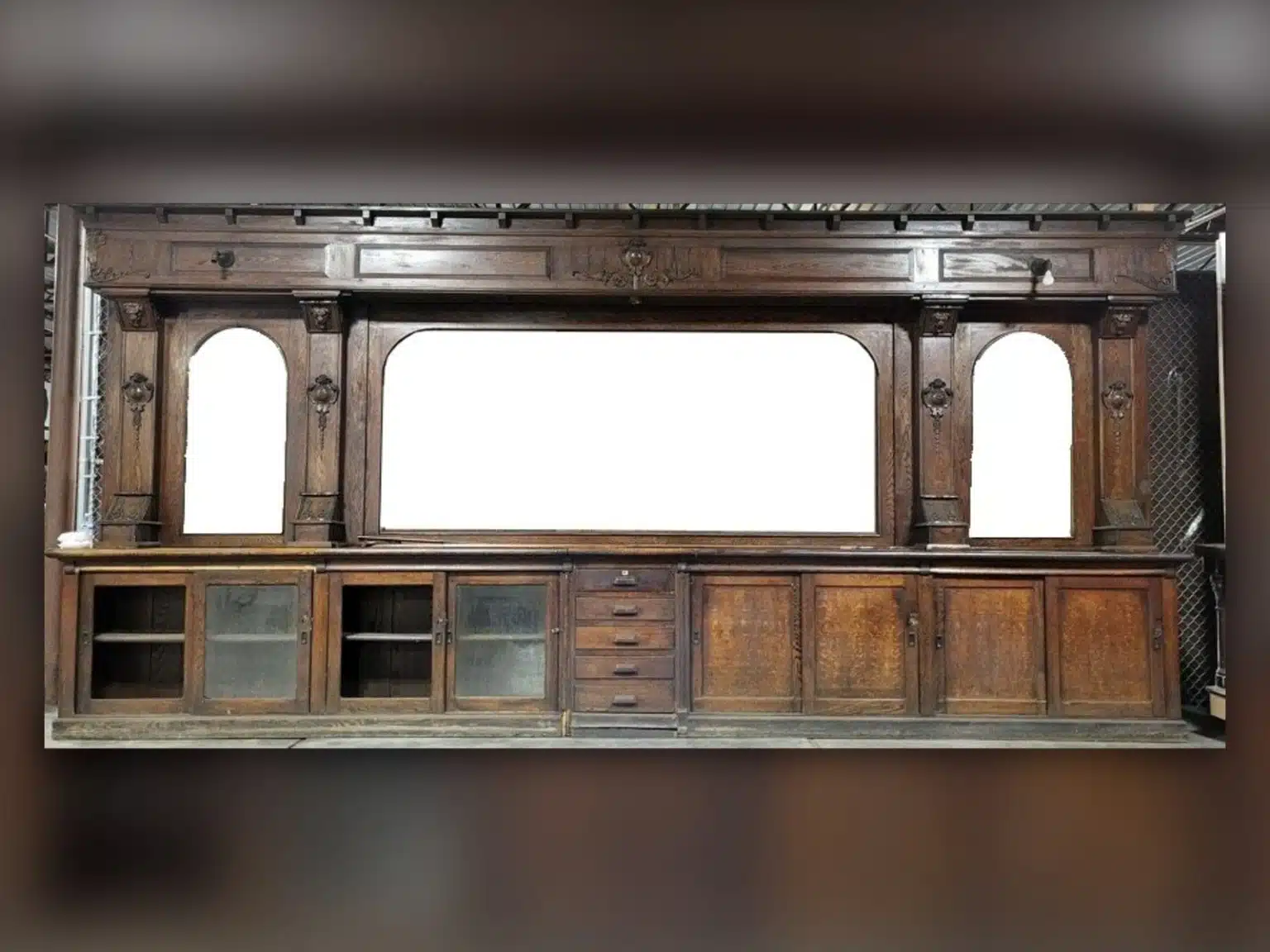
Charles Passow & Sons was a Chicago maker of saloon fixtures and billiard tables at the turn of the twentieth century, and its carved oak back bars are prized by restaurants, breweries and collectors today. Our 24-foot triple arch oak back bar dates from the early 1900s and carries the lion heads and fruit-draped crests that our listing describes as signature Passow details. Here is what the record shows about the firm, the Chicago saloon trade it served, and how to read the bar itself.
Who were Charles Passow & Sons?
The best record of the firm is its own paperwork. An advertising envelope postmarked in Chicago on November 1, 1899 presents “Chas. Passow & Sons” as manufacturers of saloon fixtures and billiard and pool tables, with views of a pool table and the firm’s office and factory. An early-1900s Passow bar catalogue describes the company as bar fixture manufacturers.
That pairing of billiard tables and bar fixtures followed the pattern of the largest firm in the business, Brunswick-Balke-Collender, which also built both and ran a large plant in Chicago. Beyond those documents, details such as the year Passow was founded and how long it stayed in business are thin in published sources, and we would rather say so than guess.
How did Chicago’s brewery-owned saloons shape the back bar trade?
Passow worked in a city full of saloons, and many of them were controlled by brewers. By the turn of the century Chicago had more than 50 breweries, and by 1900, the Encyclopedia of Chicago notes, brewers dominated most of the city’s barrooms.
The arrangement was called the tied house. According to the City of Chicago’s landmarks staff, nearly half of the city’s roughly seven thousand saloons were tied to breweries by 1893. Brewers paid license fees for saloonkeepers and rented them fixtures, equipment and furniture, sometimes the complete outfit of a new saloon from the bar itself to the kitchen sink. In return, the saloon sold only that brewer’s beer.
Competition was fierce. Schlitz alone built 57 tied houses in Chicago between 1897 and 1905, and when one brewer opened a saloon, rivals often opened their own nearby. Every one of those rooms needed a bar.
How the era ended
A 1907 law let individual Chicago precincts and wards vote themselves dry, and saloons were forced to close across two-thirds of the city. National Prohibition followed on January 17, 1920. When it was repealed on December 5, 1933, federal regulations barred the return of the tied-house system, and an independent wholesaler now stands between brewer and tavern. The fixtures made for that earlier trade are the bars collectors look for now.
How to read a carved oak back bar
- Lion heads. Our listing describes the lion heads on RA668 as a Passow signature, and at least one other Passow back bar offered on the market has been described with lions carved into its crown. Treat carving as one clue alongside the maker information, not proof on its own.
- Carved crests with trailing fruit. On RA668 the crests carry carved fruit down from the crown. Look at whether the carving on both sides matches in style and depth, which helps show the crown is one design.
- The oak itself. Quartersawn oak is cut so the growth rings run at a steep angle to the face of the board, which exposes the tree’s medullary rays as flecks or “tiger stripes” and gives a more stable board. Our listing describes RA668 as oak without naming the cut, so look closely at the grain when you visit.
- Arched mirrors. Arch-top mirror sections set the rhythm of a long bar. RA668 has three.
- Lighting. RA668 has Victorian lights mounted on either side of the crown; have a licensed electrician look at any light fixture before it is connected.
The bar on our floor: RA668
Our Passow back bar runs 24 feet in oak, with three arch-top mirrors, the signature lion heads, carved crests with trailing fruit, and Victorian lights mounted on either side of the crown. It dates from the early 1900s. Its height and depth are not listed, so call us for those before you plan your wall.
A bar of this length suits a restaurant, brewery, private club or a large home bar with the wall to carry it. The price is available on request.
For comparison, the same floor holds a 22-foot Brunswick-Balke-Collender mahogany back bar with a stained and leaded glass domed canopy (RA565), a 28-foot Rothchild back bar with marble columns (RA606) and a 16-foot Victorian mahogany back bar (RA525). See them all in Antique Back Bars.
Frequently asked questions
How big is the Passow back bar?
It is 24 feet long. Call for the height and depth before you plan your wall.
How old is the Passow back bar?
RA668 dates from the early 1900s. Period paperwork shows Charles Passow & Sons making saloon fixtures in Chicago by 1899 and issuing bar catalogues in the early 1900s.
Are lion heads a sign of a Passow bar?
Our listing describes the lion heads on RA668 as a Passow signature, and lions appear on at least one other Passow bar. Published records on the firm are thin, so treat carving as one clue rather than proof.
What was a tied house?
A tied house was a saloon bound to sell only one brewery’s beer, often in return for the brewer paying license fees or renting the saloonkeeper fixtures and furniture. Nearly half of Chicago’s saloons were tied to breweries by 1893.
Who else made antique back bars?
Brunswick-Balke-Collender was the best-known maker; read our story on Brunswick back bars. Our floor also includes a 28-foot Rothchild back bar with marble columns.
How do I plan for a bar this size?
Start with our guide to buying an antique back bar.
See it in Roswell
Every piece in this story is on the floor at the Red Baron Antiques showroom, 872 Atlanta Street, Roswell, Georgia, open Monday through Friday from 9 am to 5 pm. Call (770) 640-4604 or email [email protected] with the item number, and the team will tell you more.