

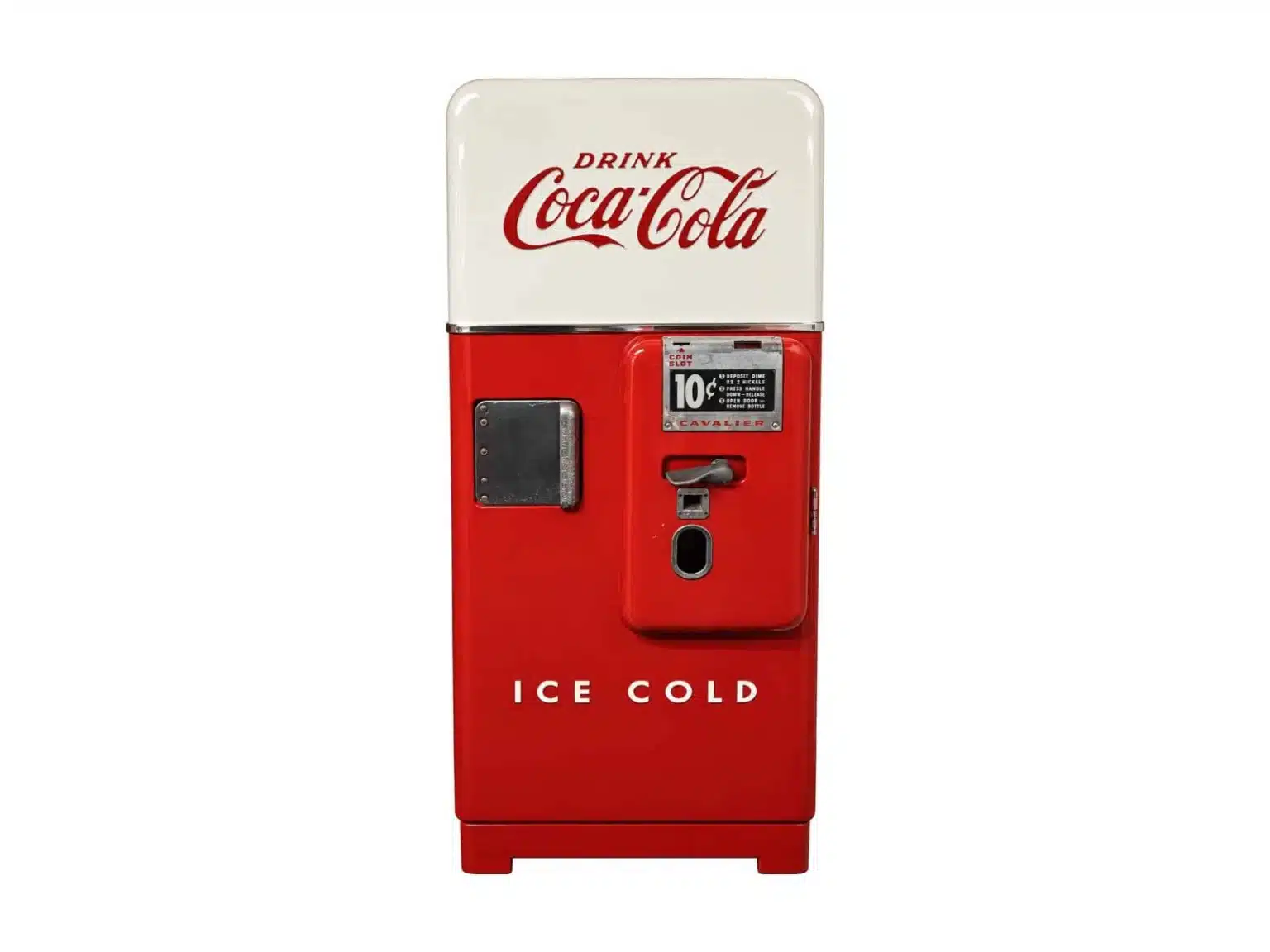
Two makers stand behind many of the classic Coca-Cola bottle machines collectors chase today: the Cavalier Corporation of Chattanooga, Tennessee, and the Mills Novelty Company of Chicago. Red Baron has one of each on the floor, a Cavalier C-51 and a Mills 65. Here is how each company came to build for Coca-Cola, what the nickel and the dime on their coin slots tell you, and what to check before you buy.
How did Coca-Cola vending machines begin?
Before coin machines came coolers. Beginning around 1929, Coca-Cola placed a standardized cooler built by the Glascock Brothers Manufacturing Company of Muncie, Indiana, and more than a million went into service over roughly 25 years.
Coin operation followed. By 1937, according to Coca-Cola’s own history, the company had decided coin-operated coolers were ready to recommend nationally, and makers such as Mills of Chicago, Vendo of Kansas City and Westinghouse of Pittsburgh went on to build the machines that put a cold bottle within reach for a coin.
Cavalier of Chattanooga
Cavalier began as the Tennessee Furniture Company, a Chattanooga sawmill business that opened in 1865, according to the company records held by the University of Tennessee at Chattanooga. In 1905 it bought the Odorless Refrigeration Company and grew into the country’s largest maker of ice coolers. It adopted the Cavalier name for its cedar hope chests and soda coolers in 1923 and officially became the Cavalier Corporation in 1938.
During the Depression, Cavalier began a long relationship with Coca-Cola, building soda machines, coolers and picnic chests, and it made products exclusively for Coca-Cola through the 1960s. Among its vending firsts was a machine that dispensed both bottles and cans. Seeburg took over the company in the 1960s, and Cavalier closed in August 2000.
The C-51 is one of the upright bottle machines from the company’s Coca-Cola years. Collector references place the model in the 1950s but disagree on the exact year it was introduced, so we do not put a single date on it.
Mills of Chicago
Mills grew from a cigar-vending business that Mortimer Mills started in Chicago in the 1890s. The company became known for coin-operated machines of every kind, from slot machines and jukeboxes to the Violano-Virtuoso, a self-playing violin and piano.
Around 1935, Coca-Cola engaged Mills to build a standing, automatic, cooled bottle vendor. Coca-Cola’s history, quoting collector Jeff Walters, describes the resulting Mills Model 47 of 1938 as an early automatic machine built for workplaces and the only machine ever made that vended bottles crown first. The company changed its name to Mills Industries in 1943 and was acquired by the F. L. Jacobs Company in 1954. The listing for our Mills 65 names its maker as Mills Industries of Chicago.
Why does a 5¢ or 10¢ coin slot matter?
A bottle of Coca-Cola cost a nickel from 1886 until about 1959. Fixed-price syrup contracts and decades of “5 cents” advertising made the price hard to raise, and so did the machines, which took only nickels. Coca-Cola even asked the U.S. Treasury for a 7½-cent coin, and the request was turned down.
Our two machines sit on either side of that story: the Mills 65 is a 5¢ machine, and the Cavalier C-51 is set for a dime. Machines kept changing after that, too. Coca-Cola’s history notes that by 1960 a Westinghouse machine could vend cans or bottles of several products at different prices, as new brands made bottle-only machines less practical.
What collectors look for in a vintage Coke machine
- Originality. Unrestored machines with original paint and decals have their own following; well-done restorations have theirs. Ask which you are looking at.
- The coin mechanism. Ask whether it accepts coins and makes change, and which coin it is set for.
- Cooling. Ask whether the refrigeration has been tested, and have a refrigeration technician look at any older system before you rely on it.
- The interior. Check for the bottle rack, the vending mechanism and the maker’s identification plate.
- Graphics. Look for clean Coca-Cola script and period panels such as “Ice cold in bottles.”
- Size. These are tall cabinets, so measure doorways and the spot where the machine will stand.
On our floor
- Vintage Cavalier C-51 Coca-Cola 10¢ vending machine (RC4790): the upright cabinet style of mid-century bottle vending, with full Coca-Cola branding. Cavalier Model C-51, 10¢. Approx. 66.5″ H × 27″ W × 26″ D. See the photos for cosmetic condition and originality.
- Vintage Mills 65 Coca-Cola 5¢ vending machine (RC4789): unrestored and in original condition, with its red cabinet, Coca-Cola script, stainless trim and period “Ice cold in bottles” panel. The coin mechanism is functional, accepting coins and making change. Inside are the original bottle rack, mechanism, refrigeration and Mills identification plate. Approx. 67″ H × 22″ W.
For another piece of vending history, read about our 1947 English Ford E83W vending truck.
Frequently asked questions
Do the machines work?
The Mills 65’s coin mechanism works, accepting coins and making change. Ask the showroom about cooling and anything else before you buy.
Where can I see more coin-op pieces?
Browse Coin-Op & Vending.
Who made Cavalier Coca-Cola machines?
The Cavalier Corporation of Chattanooga, Tennessee, which grew out of the Tennessee Furniture Company, a sawmill business that opened in 1865. It made products exclusively for Coca-Cola through the 1960s.
Who made Mills Coca-Cola machines?
The Mills Novelty Company of Chicago, renamed Mills Industries in 1943. Coca-Cola engaged Mills around 1935 to build an automatic bottle vendor.
Why did a Coke cost a nickel for so long?
Coca-Cola held at five cents from 1886 until about 1959, kept there by fixed-price syrup contracts, years of “5 cents” advertising and vending machines that accepted only nickels.
Is the Mills 65 restored?
No. It is unrestored and in original condition, with its original bottle rack, mechanism, refrigeration and Mills identification plate.
How big are the machines?
The Cavalier C-51 is approximately 66.5″ H × 27″ W × 26″ D, and the Mills 65 is approximately 67″ H × 22″ W.
See it in Roswell
Every piece in this story is on the floor at the Red Baron Antiques showroom, 872 Atlanta Street, Roswell, Georgia, open Monday through Friday from 9 am to 5 pm. Call (770) 640-4604 or email [email protected] with the item number, and the team will tell you more.