

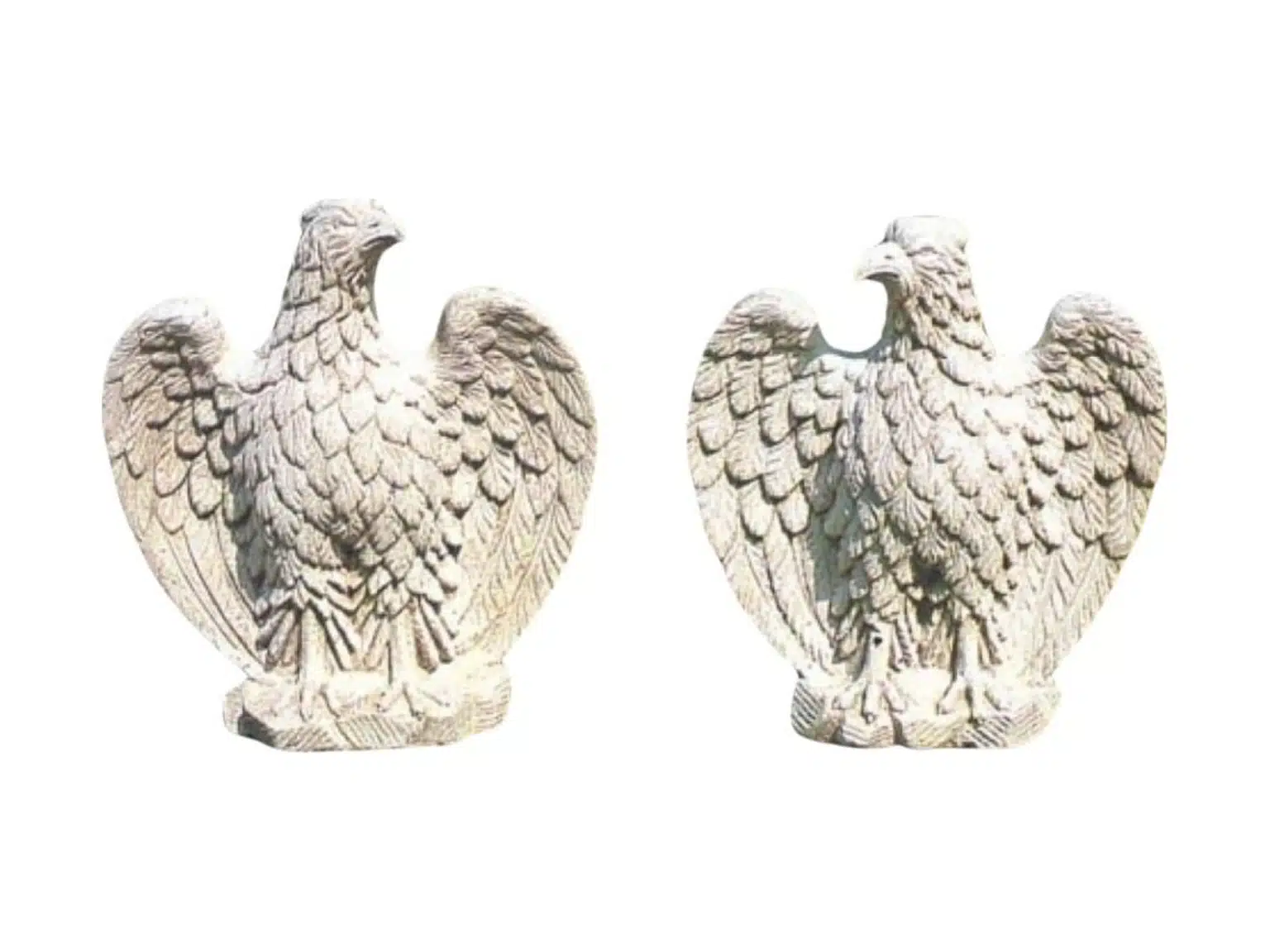
Pairs of animals flanking a gate or a front walk are an ancient idea in architecture and garden design: they announce an entrance and give it presence. We have guardian pairs in stone and cast aluminum, including large seated stone entry eagles and cast aluminum lions with one paw raised, along with cast iron and cast stone pieces for a lawn, terrace or garden wall.
Why are lions placed at gates?
Lions have guarded entrances since the Bronze Age. The Lion Gate at Mycenae in Greece, the monumental entry to the citadel, is crowned by two rampant lions resting their forepaws on a pedestal that supports a column.
In traditional Chinese culture, guardian lions protect buildings from harmful spiritual influences. They come as a male and female pair: the male rests a paw on an embroidered ball, representing the material world, and the female rests hers on a cub, representing nature and the cycle of life. The pair at the entrance to the Formal Gardens of Australia’s Parliament House face one another across the way in.
Our pair of cast aluminum lions (RY32) sits in that classic guardian pose, each with one paw raised.
Why the eagle reads as American
On June 20, 1782, Congress adopted the Great Seal of the United States after six years of discussion. Its face shows a bald eagle holding an olive branch in its right talon and arrows in its left, standing for the powers of peace and war. Ever since, an eagle on a gatepost, a front step or a driveway pillar has carried a clear American association.
Our two pairs of seated stone entry eagles suit that kind of placement: one pair mirrored to face left and right, the other seated on rock bases.
Stone, cast stone, cast iron or cast aluminum?
- Stone is natural and carved. English Heritage research on marble statuary found that wet stone exposed to freezing temperatures can suffer freeze–thaw damage, with cracked, porous, aged stone most at risk.
- Cast stone is a refined architectural concrete made to simulate natural cut stone, in the Cast Stone Institute’s definition. Concrete expands and contracts with temperature and humidity, and water freezing on it can make the surface shale and crack.
- Cast iron has one main enemy outdoors: rust. The National Park Service calls rust one of the leading causes of iron deterioration and notes that paint inhibits it.
- Cast aluminum weighs about one-third as much as iron, and a naturally occurring oxide film on its surface gives it good corrosion resistance.
Bacchus, hunting dogs and a horse
Bacchus is a name for Dionysus, the god of wine; the Romans also called him Liber. In art his attributes include a drinking vessel, an ivy wreath, grape vines and the thyrsus, a fennel staff wreathed in ivy and usually tipped with a pine cone. Our cast stone Bacchus head with grapes and vines (BY454) is a wall or garden ornament that suits a wine cellar entrance, an outdoor bar or a vine-covered wall; see also our guide to wine cellar antiques.
Sporting animals suit a different mood. The cast iron hunting dogs (RD1853) are a single sculpture of two dogs on one base, suited to a garden, a lodge or an entry, and the cast stone horse head (RD1892), with its aged stone finish, suits a garden wall or bed.
On our floor
- Pair of large seated stone entry eagles (BY5204): facing left and right; 30″ H × 27.5″ W × 15″ D.
- Pair of tall seated stone entry eagles (BY5210): seated on rock bases; 30″ H × 16″ W × 10″ D.
- Pair of cast aluminum lion statues (RY32): classic guardian pose, each with one paw raised; each 46″ H × 39″ L × 20″ W.
- Cast iron hunting dogs sculpture (RD1853): two hunting dogs on one base; 33″ H × 36″ L × 22″ W overall.
- Cast stone horse head garden accent (RD1892): aged stone finish; 23″ H × 24″ D × 7.5″ W.
- Cast stone Bacchus head with grapes and vines (BY454): wall or garden ornament; 24″ H × 24″ W.
How to place a pair of entry statues
- Check the footprint. A gatepost cap or pier has to be at least as deep and wide as the statue’s base: 15″ deep for the large eagles (BY5204), 10″ deep for the tall eagles (BY5210).
- Mind the direction. A mirrored pair such as BY5204 suits flanking an entrance; decide whether they should look out toward visitors or turn toward each other across the walk.
- Judge the scale. Mock up the height with boxes and view it from the street before committing.
- Use a firm, level base and have a mason or landscape contractor plan how heavy pieces will be set and secured.
For a centerpiece between the guardians, see our guide to choosing a tiered garden fountain.
Caring for outdoor statuary through winter
Oregon State University Extension advises keeping water from collecting on concrete garden pieces and either storing a statue indoors or covering it with plastic for the winter. For valuable stone, choose covers carefully: English Heritage found some covers kept statues wetter than leaving them bare, while a breathable, insulated close-wrap gave the best protection against surface wetness.
For cast iron, the Park Service recommends removing loose rust with a wire brush, then applying a rust converter, a primer and several coats of paint made for outdoor metal.
Frequently asked questions
Can these stay outside year-round?
Statuary in these materials is commonly kept outdoors, but winter care matters. Keep water from collecting and freezing on stone and cast stone, and keep cast iron painted so it does not rust.
Why are guardian lions placed in pairs?
In Chinese tradition the pair is male and female: the male rests a paw on a ball for the material world, the female on a cub for nature and the cycle of life. Together they protect the building they flank.
Why is the eagle an American symbol?
Congress adopted the Great Seal of the United States, with a bald eagle at its center, on June 20, 1782. The eagle has stood for the nation ever since.
Is cast aluminum lighter than cast iron?
Yes. Aluminum weighs about one-third as much as iron and forms a natural oxide film that resists corrosion.
How do I keep cast iron statuary from rusting?
Keep it painted. Brush off loose rust, apply a rust converter, then a primer and several coats of paint designed for outdoor metal.
Who is Bacchus?
Bacchus is a name for Dionysus, the god of wine. Grape vines, an ivy wreath and a drinking vessel are among his attributes in art.
Where can I see all of the statuary?
Browse Statuary & Sculpture.
See it in Roswell
Every piece in this story is on the floor at the Red Baron Antiques showroom, 872 Atlanta Street, Roswell, Georgia, open Monday through Friday from 9 am to 5 pm. Call (770) 640-4604 or email [email protected] with the item number, and the team will tell you more.