

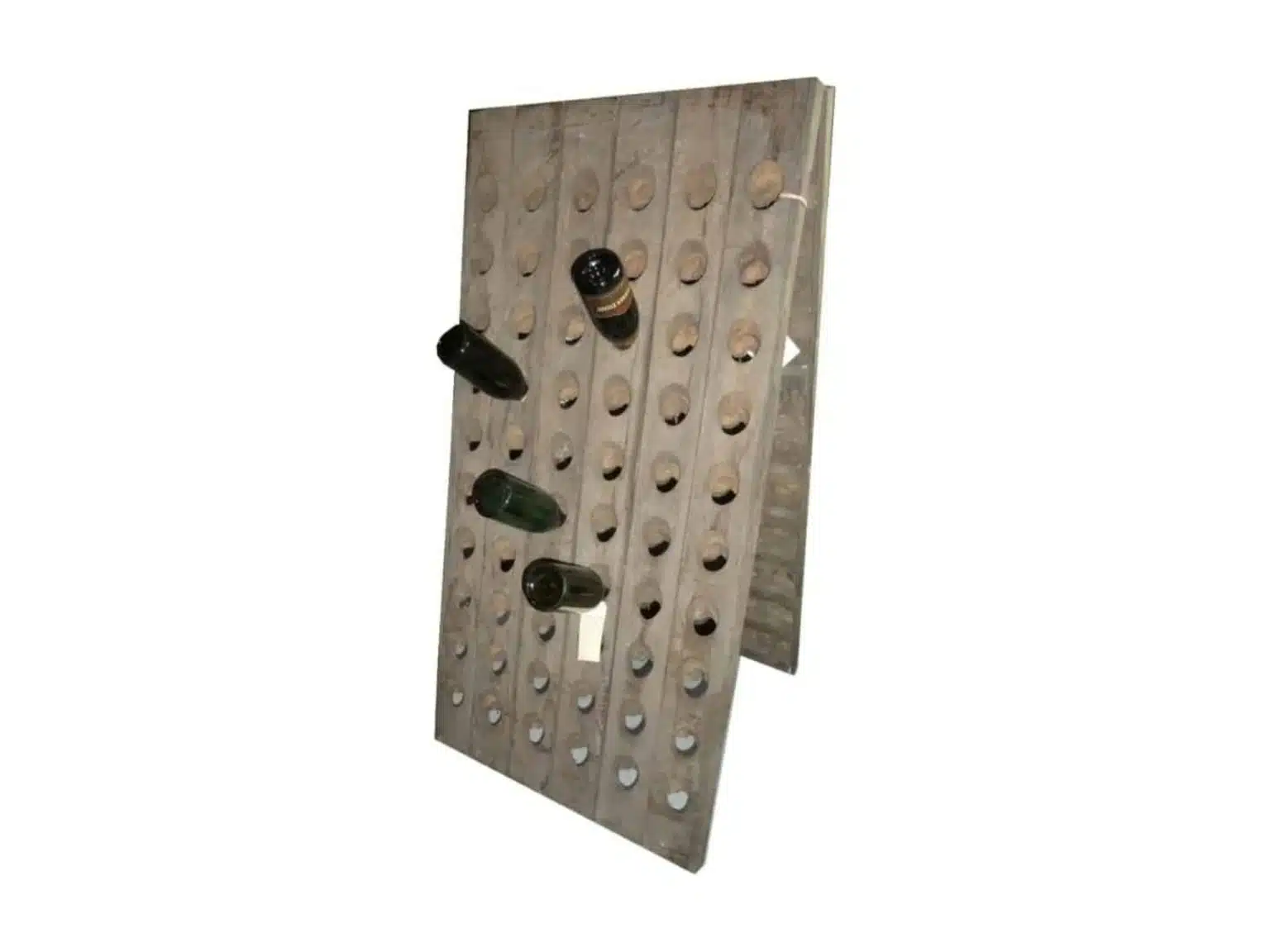
The best wine cellar decor comes from wine itself: the tools and vessels of the winemaker. Red Baron has a French A-frame champagne riddling rack that holds 120 bottles, French wine barrel ends marked Vieux St Emilion, and a pair of nickel-over-bronze cigar cutters. Together they can anchor a cellar, tasting room or wine bar.
What is a riddling rack?
A riddling rack, or pupitre in French, is a wooden frame drilled with angled holes that hold champagne bottles neck-down. It belongs to the traditional method of making champagne, in which the sparkle comes from a second fermentation inside the bottle. That fermentation leaves a deposit of spent yeast, and riddling (remuage) gathers it in the neck so it can be removed in the step called disgorgement.
How riddling works
According to the Union des Maisons de Champagne, the trade body of the champagne houses, the riddler (remueur) gives each bottle a quarter, an eighth or a sixteenth of a turn, gradually tilting it until the neck points down. On a pupitre the change of angle is limited to about 30 degrees. By hand, the cycle takes about a week resting neck-down followed by at least 26 to 30 days of riddling, and the best remueurs could turn as many as 75,000 to 80,000 bottles a day.
Who invented it?
Riddling is traditionally credited to the house of Veuve Clicquot in Reims in the early 1800s. The usual story gives the idea to Madame Clicquot and her cellar master Antoine Müller, who cut angled holes in a table so bottles could be turned in place; sources date it anywhere from about 1813 to 1818. The houses’ own history adds that a worker named Thomassin, at the house of Morzet, put the idea into practice, and that in 1864 a Monsieur Michelot patented the pupitre as we know it today, with a traditional capacity of 120 bottles.
From hand to machine
Hand riddling gave way to the gyropalette, a cage that turns many bottles at once. Jacques Ducoin and Claude Cazals filed a patent for a riddling cage in 1968, the first prototype followed in 1973, and a large Piper-Heidsieck order in 1978 marked the turning point. The Union des Maisons de Champagne now describes the gyropalette as virtually universal in Champagne.
Saint-Émilion and its barrels
Saint-Émilion lies on the Right Bank of the Dordogne, about 35 kilometers east of Bordeaux, between Libourne and Castillon-la-Bataille. The Romans planted vineyards there as early as the second century, and in the fourth century the poet Ausonius praised the local wine. Merlot and Cabernet Franc dominate its vineyards, and its wines have had their own classification since 1955.
In 1999 UNESCO inscribed the Jurisdiction of Saint-Émilion as a World Heritage site, describing an exceptional landscape devoted entirely to wine-growing. Barrels are the working tools of that landscape, which is why barrel ends marked with the name carry so well onto a cellar wall.
Cigar cutters at the bar
Writing in the Journal of Antiques & Collectibles, auctioneer Michael Eckles places the cigar’s peak between the end of the Civil War and the rise of the cigarette in the early twentieth century. In that era, purpose-made cigar cutters sat on saloon counters and in cigar stores and tobacconists, replacing the scissors and matches that once served. Eckles lists nickel-plated brass and cast iron, as well as Vienna bronze, among their materials, and calls condition by far the most important factor for collectors.
On our floor
- French A-frame champagne riddling rack (RF635): a French A-frame riddling rack that holds 120 bottles.
- French wine barrel ends, Vieux St Emilion (RC2961): original French wine barrel ends marked Vieux St Emilion, 38 inches in diameter.
- Pair of nickel-over-bronze cigar cutters (KM300AC): a lot of two nickel-over-bronze cigar cutters.
Putting a wine room together
- Let the rack do two jobs. Use the riddling rack as a bottle display or a room divider.
- Hang barrel ends where a painting would go. At 38 inches across, the Saint-Émilion ends make a strong focal point over a tasting table or sideboard.
- Add champagne advertising. Our hand-painted Moët & Chandon, Pommery and Lanson panels are covered in our story on hand-painted champagne advertising.
- Finish with the bar. Set the cigar cutters on a sideboard or bar top, and browse Wine, Bar & Smoking for more.
Keep storage and display separate
Wine Spectator recommends a constant 55 degrees and about 70 percent humidity for long-term wine storage, mainly to keep corks from drying out. That is damper than archivists allow for their own collections: the U.S. National Archives advises keeping relative humidity below 65 percent to discourage mold. If your cellar is kept for the wine, hang painted signs and advertising in the adjoining tasting room or bar rather than in the storage space itself.
Frequently asked questions
How many bottles does the rack hold?
Our French A-frame riddling rack (RF635) holds 120 bottles, which the champagne houses describe as the traditional capacity of a pupitre.
What is a riddling rack used for?
It holds champagne bottles neck-down at an angle while they are turned by hand, so the yeast deposit from the second fermentation collects in the neck for removal.
Who invented riddling?
Riddling is traditionally credited to the house of Veuve Clicquot in Reims, with Madame Clicquot and her cellar master Antoine Müller, in the 1810s. The pupitre in its familiar form was patented by Michelot in 1864.
Is champagne still riddled by hand?
Mostly not. Automated gyropalettes, developed from 1968 and widely adopted after 1978, are now described by the champagne houses as virtually universal in Champagne.
Where is Saint-Émilion?
Saint-Émilion is on the Right Bank of the Dordogne, about 35 kilometers east of Bordeaux. Its wine-growing landscape has been a UNESCO World Heritage site since 1999.
What temperature should a wine cellar be?
Wine Spectator recommends a constant temperature near 55 degrees Fahrenheit and about 70 percent humidity for long-term storage.
Where can I see more wine and bar antiques?
Browse Wine, Bar & Smoking.
See it in Roswell
Every piece in this story is on the floor at the Red Baron Antiques showroom, 872 Atlanta Street, Roswell, Georgia, open Monday through Friday from 9 am to 5 pm. Call (770) 640-4604 or email [email protected] with the item number, and the team will tell you more.