

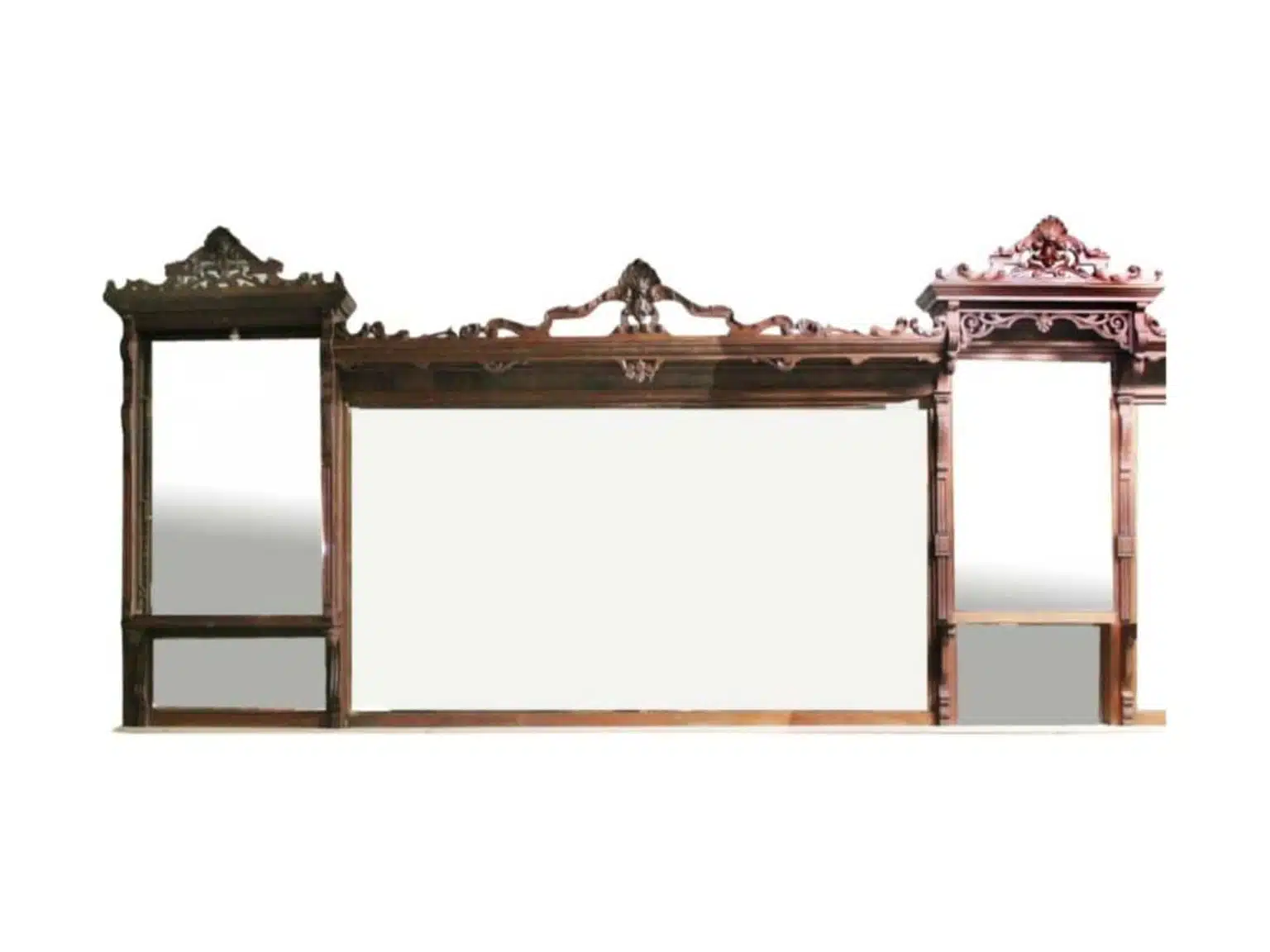
In the grander American saloons and hotel bars of the late 1800s, large oil paintings hung alongside the carved back bar and its mirrors, and figure paintings of the nude became a recognized part of that décor. One painter whose name is closely tied to the genre is the Californian Astley David Middleton Cooper (1856–1924). Red Baron has an original signed A.D. Cooper along with a second saloon painting in the same tradition.
What is a saloon or “barroom nude” painting?
The term describes large figure paintings, usually oil on canvas, made or bought to hang in saloons and hotel bars. Early frontier saloons were often plain, but as towns grew, many were elaborately decorated, with fine glassware and oil paintings on the walls. Some breweries, Schlitz among them, built ornate saloons to attract customers and advertise their beer.
Photographs and illustrations of late-19th-century bars show back bars built of paneled millwork, often set with mirrors, with bottles arranged in tiers. A large framed painting completed that setting, much as it can complete a bar room today.
The painting in New York’s Hoffman House bar
A well-documented example hung in New York. William-Adolphe Bouguereau painted Nymphs and Satyr in 1873, an oil on canvas more than eight and a half feet tall, drawn from classical mythology. Edward S. Stokes bought it in 1882 and owned it until his death in 1901, and it was displayed in the bar of the Hoffman House hotel until that year. A view of the bar made in March 1890 shows the painting in place.
Sterling Clark first encountered the painting at the Hoffman House and acquired it in 1942. Since 1955 it has belonged to the Clark Art Institute in Williamstown, Massachusetts.
Saloon art as advertising: “Custer’s Last Fight”
Not every saloon painting was a figure study. Cassilly Adams’s painting Custer’s Last Fight, made in the mid-1880s, hung in a saloon for several years and gained a considerable local reputation. When the saloon’s owner died, Anheuser-Busch acquired the painting through a creditors’ claim.
F. Otto Becker adapted it as a color lithograph for the brewery, copyrighted in 1896. The Smithsonian’s National Museum of American History records that the print went to saloons, dining establishments and barber shops, more than a million copies by Anheuser-Busch’s count.
Who was A.D.M. Cooper?
Astley David Middleton Cooper was born in St. Louis on December 23, 1856. An 1892 profile in the San Jose Daily Mercury says his father was a well-known St. Louis surgeon and that he completed his education at Washington University in St. Louis.
History San José notes that his grandfather was Major Benjamin O’Fallon, that his great-great-uncle was William Clark of the Lewis and Clark Expedition, and that the painter George Catlin, a family friend, was his greatest influence. As a young man Cooper traveled through Colorado and north into Montana and Wyoming, painting portraits of Native Americans.
He established himself as a professional artist in San Francisco and, according to History San José, moved to East San Jose in 1883. In 1909 he built a studio at San Antonio and South 21st Streets designed as a replica of an Egyptian temple; it was torn down in the 1940s. He died in San Jose on September 10, 1924.
His subjects and reputation
Cooper painted Native American and Western scenes, portraits, landscapes and allegories, and the 1892 Mercury profile called nude figures his specialty. In 1897 Jane Stanford commissioned him to paint her jewels, a canvas now held by Stanford’s Cantor Arts Center and the subject of a 2015 exhibition there. Curator Annie Ronan has described Cooper as arguably the best-known and most financially successful painter in California in his day.
Did Cooper pay his bar bills with paintings?
The story is part of his local reputation. History San José describes him as notorious for throwing huge parties and paying his bar bills with paintings of nudes, and auction-house biographies repeat that many establishments in the area displayed his canvases. American Heritage recounts that a duplicate of the Stanford jewel painting turned up in a San Jose saloon window, apparently traded for drinks. Treat the colorful details as lore; the consistent thread is that his canvases hung in local saloons.
What to ask before buying a large oil painting
- Signature: where it is and how it reads. Our RP232 listing describes that painting as signed A. D. Cooper.
- Lining: lining means attaching a new fabric support to the back of a canvas, usually because the original has weakened. Ask whether a painting has been lined.
- Varnish and past treatment: varnish protects the paint and saturates its colors. Ask about earlier cleaning or retouching.
How to hang and care for a large oil painting
These points follow guidance from the Smithsonian’s Museum Conservation Institute.
- Use sturdy hardware sized for the weight, with hooks driven into wall studs; for heavy works, add proper anchors and a bracket beneath the painting.
- Avoid hanging over a fireplace, where heat, soot and smoke can permanently darken a painting, and keep it away from heat sources and direct sunlight.
- Keep humidity moderate and steady.
- Dust only with a clean, soft, natural-hair brush, never a cloth or feather duster.
- Move a large painting with two or more people, holding the sides of the frame, and consult a paintings conservator about anything beyond routine care.
On our floor
- RP232, original barroom nude by A. D. Cooper: oil on canvas, signed A. D. Cooper, approximately 3′ wide × 5′ high.
- RP227, saloon barroom nude: oil on canvas in the tradition of paintings that hung behind the great American bars; 93″ high × 42″ wide overall, in its frame. The artist is not listed.
- RA525, 16′ Victorian mahogany back bar, shown at the top of this story.
Frequently asked questions
Who was A.D.M. Cooper?
Astley David Middleton Cooper (1856–1924) was a St. Louis-born painter who settled in San Jose, California. He painted Western and Native American subjects, portraits, landscapes and nude figure studies.
Is the Cooper painting signed?
Yes, our listing describes it as signed A.D. Cooper.
Did Cooper really pay bar tabs with paintings?
History San José describes him as notorious for paying his bar bills with paintings of nudes, and several biographies say his canvases hung in local saloons. The specific anecdotes are best treated as local lore.
What famous painting hung in a New York bar?
Bouguereau’s Nymphs and Satyr (1873) was displayed in the bar of the Hoffman House hotel in the late 1800s. It now belongs to the Clark Art Institute in Williamstown, Massachusetts.
What goes with saloon art?
An antique back bar. See Antique Back Bars.
See it in Roswell
Every piece in this story is on the floor at the Red Baron Antiques showroom, 872 Atlanta Street, Roswell, Georgia, open Monday through Friday from 9 am to 5 pm. Call (770) 640-4604 or email [email protected] with the item number, and the team will tell you more.