

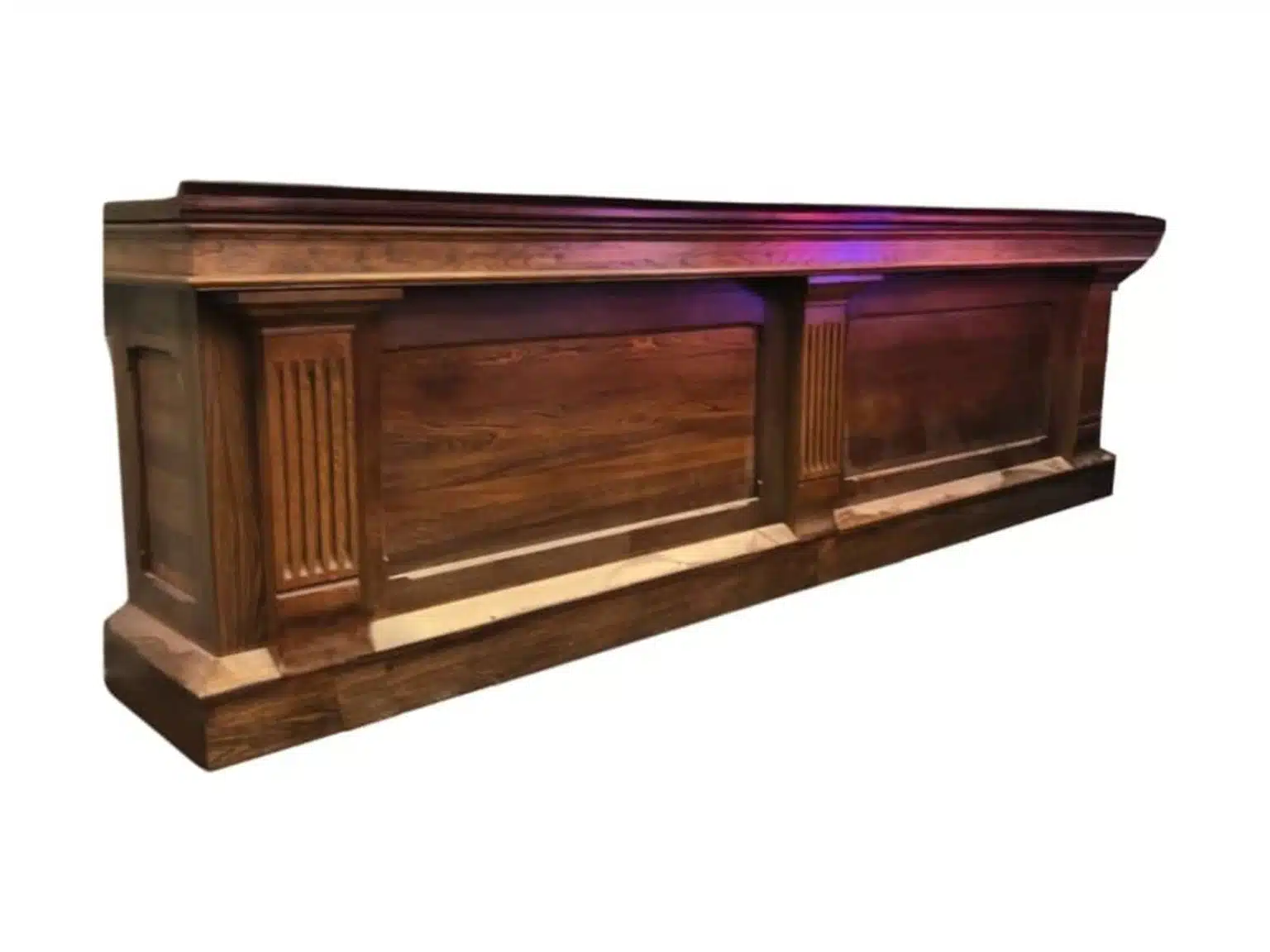
Our 12-foot mahogany front bar has Morgan silver dollars embedded in the left side of its lacquered top, which ties a working bar to one of the most collected coins in American history. The bar is 12 feet long, 44 inches high and 29.5 inches deep. Here is the history behind the coin, and how to plan for and care for the bar.
What is a Morgan silver dollar?
The Morgan dollar is named for its designer, George T. Morgan, an English-born engraver who joined the U.S. Mint at Philadelphia in 1876. The front carries a profile of Liberty; the reverse shows an eagle with outstretched wings holding arrows and an olive branch.
Morgan’s model for Liberty was Anna Willess Williams, a Philadelphia teacher who sat for him in 1877. The coin was a product of politics: the Bland–Allison Act, passed over President Rutherford B. Hayes’s veto on February 28, 1878, required the Treasury to buy silver every month and coin it into dollars. Morgan dollars were first struck for circulation in March 1878.
Morgan dollar key facts
- Years struck: 1878 to 1904 and 1921 for the original series; the U.S. Mint has issued collector Morgan dollars since 2021.
- Composition: 90 percent silver and 10 percent copper.
- Weight and size: 26.73 grams and 38.1 millimeters across, containing about 0.7734 troy ounce of pure silver.
- Mints: Philadelphia (no mint mark), New Orleans (O), San Francisco (S), Carson City (CC) and, in 1921 only, Denver (D).
Why so many Morgan dollars were melted, and so many survive
The Mint struck far more silver dollars than the public needed. According to PCGS, some circulated, particularly in the West, where hard money was favored over paper, but millions were bagged and stored in government vaults.
In 1918 the Pittman Act authorized melting silver dollars, and 270,232,722 of them went to the melting pot, most of that silver sold to the United Kingdom. Then, in 1921, the Mint struck more than 85 million new Morgan dollars, the final year of the original series.
Later, about 2.8 million Carson City dollars held back by the Treasury were sold by the General Services Administration in a series of mail-bid sales between 1972 and 1980. PCGS notes that a 1993 Coin World survey found Morgan dollars to be the most popular of the older United States coin series.
Silver dollars in a bar: the Wort Hotel’s Silver Dollar Bar
Setting silver dollars into a bar has a well-known American example. In 1950 the Wort Hotel in Jackson Hole, Wyoming, added its Silver Dollar Bar, inlaid with 2,032 uncirculated Morgan silver dollars.
The bar survived a 1980 fire that badly damaged the hotel, and the Wort was listed on the National Register of Historic Places in 1999. Our bar makes the same kind of statement at a smaller scale: Morgan silver dollars embedded in the left side of a lacquered mahogany top.
Front bar or back bar?
A front bar is the counter where drinks are served and guests stand or sit. The back bar is the tall cabinet behind the bartender, traditionally fitted with mirrored panels and shelves for bottles. Our Morgan dollar bar is a front bar, and it pairs naturally with a back bar such as our 16-foot Victorian mahogany back bar.
For a larger room, our 22-foot Brunswick mahogany back bar and our 24-foot Passow triple arch back bar in oak are also on the floor. Read about both makers in our stories on Brunswick-Balke-Collender back bars and Charles Passow & Sons.
Planning your space: height, seating and the parts of a bar
The modern rule of thumb for a bar counter is 42 inches high, with stools whose seats sit about 30 inches off the floor. At 44 inches, our bar stands two inches above that standard, so measure stools against it before you buy them.
Allow at least 24 inches of bar per seated guest, or 30 inches where space permits; by that measure a 12-foot bar seats five or six. It suits a home bar, game room, restaurant, pub or club.
- Bar top: the working surface, here lacquered mahogany with the coins set into the left side.
- Foot rail: where fitted, it typically sits seven to nine inches off the floor.
- Drip lip: a thin raised strip on the service side that keeps spills from running off the top.
How to care for a lacquered bar top
Conservation guidance for furniture finishes, including the Canadian Conservation Institute’s, comes down to a few habits.
- Wipe up spills promptly and keep standing water, vases and plants off the finish.
- Clean with a barely dampened soft cotton cloth, tested first on a hidden spot, and dry it right away.
- Skip commercial polishes and “restorers.” Many contain waxes, oils or silicones that build up, attract dust and make later repairs harder.
- Limit strong light, which breaks down finishes over time, and keep humidity steady, since swings make wood expand and contract.
- For damage to the finish or anything beyond gentle cleaning, consult a furniture conservator first.
On our floor
- RA657, 12′ Mahogany Front Bar with Morgan Silver Dollar Top: mahogany front bar with a lacquered top and Morgan silver dollars embedded on the left side; 12′ long × 44″ high × 29.5″ deep.
- RA525, 16′ Victorian Mahogany Back Bar: Victorian, mahogany, 16′ long.
- RA565, Brunswick 22′ mahogany back bar with stained glass canopy, about 22.5′ wide × 12′ high.
- RA668, Passow 24′ triple arch back bar in oak.
Browse more counters in Antique Front Bars and Antique Back Bars.
Frequently asked questions
How big is the bar?
The RA657 front bar is 12 feet long, 44 inches high and 29.5 inches deep.
Where are the coins?
The Morgan silver dollars are embedded in the lacquered top on the left side.
How many coins are in the top, and what dates are they?
Our listing does not state the number or dates of the coins. Contact the showroom with item number RA657 and the team will tell you more.
What is a Morgan silver dollar?
It is a U.S. silver dollar designed by George T. Morgan and struck from 1878 to 1904 and in 1921 for the original series, with collector issues from the U.S. Mint since 2021. Each original coin is 90 percent silver, weighs 26.73 grams and measures 38.1 millimeters across.
Is 44 inches a standard bar height?
The common standard for a bar counter is 42 inches, so this bar is two inches taller. Check stool heights against it; stools for a 42-inch bar usually have seats about 30 inches high.
How do I plan for a bar?
Read our guide to buying an antique bar.
See it in Roswell
Every piece in this story is on the floor at the Red Baron Antiques showroom, 872 Atlanta Street, Roswell, Georgia, open Monday through Friday from 9 am to 5 pm. Call (770) 640-4604 or email [email protected] with the item number, and the team will tell you more.