

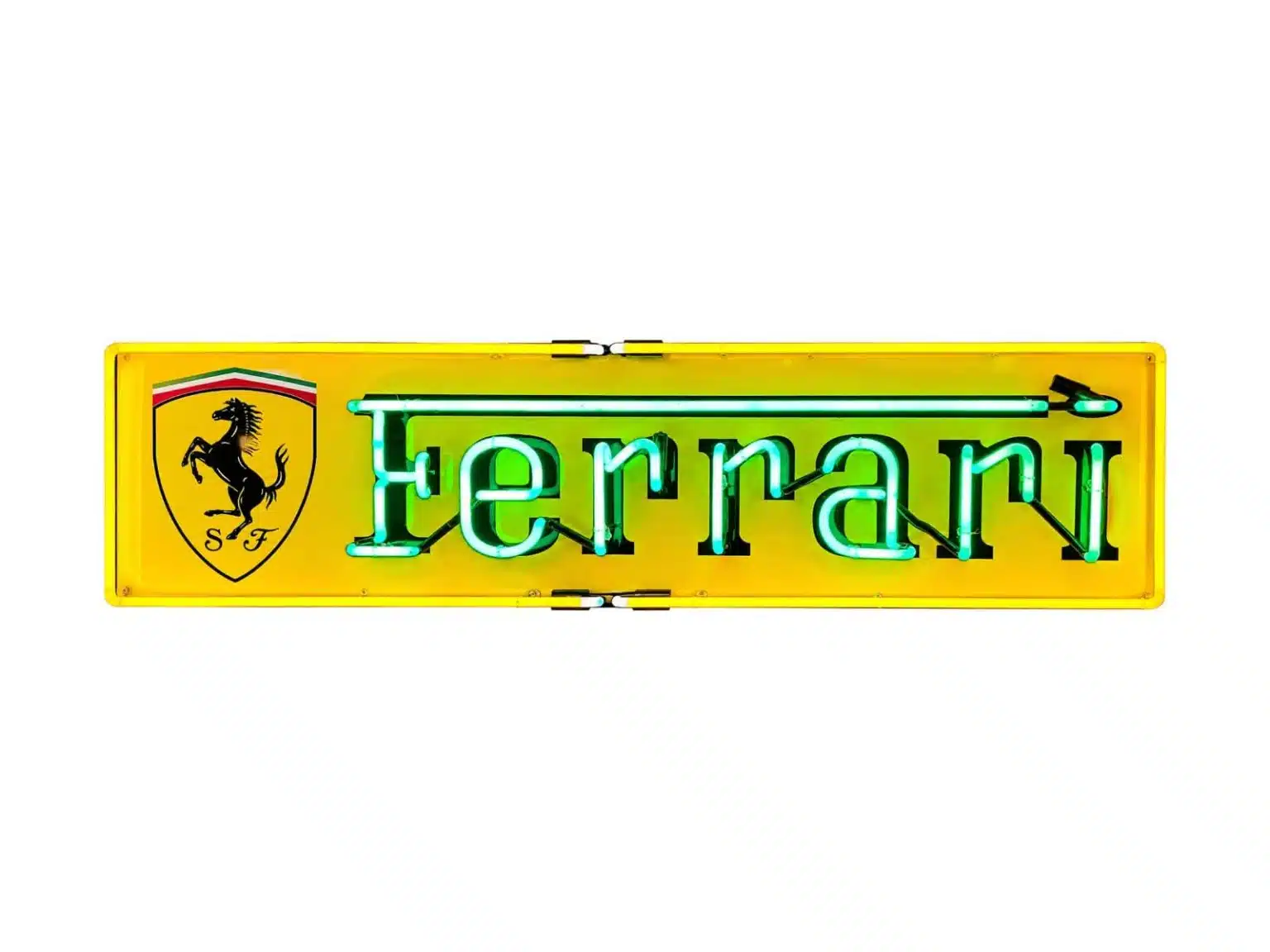
A neon dealer sign brings the glow of the car showroom indoors, and neon and the automobile have been linked since neon light’s first big public showing at the 1910 Paris Motor Show. Red Baron has dealer neon from Ferrari, Porsche and Chevrolet Super Service, along with two showpieces, an animated Shooting Gallery sign and a big fish. All five are on our floor in Roswell, Georgia.
How did neon end up on car dealerships?
Neon is a young discovery: William Ramsay and Morris Travers identified the gas in London in 1898 and named it from the Greek for “new.”
The French engineer Georges Claude turned it into light. His first large public demonstration, a pair of long red neon tubes, was staged at the Paris Motor Show in December 1910, so neon made its debut surrounded by automobiles.
The car connection crossed the Atlantic too. The usual story is that in 1923 Earle C. Anthony, a Packard dealer in Los Angeles, bought two PACKARD signs from Claude’s company, often called the first neon advertising signs in the United States. Historians have not found conclusive records of the sale, but the story fits: car dealers wanted to be seen from the road, and neon could be seen.
How does a neon sign work?
A neon sign is made by hand. A glass bender heats tubing over a flame and shapes it into letters or outlines, then an electrode is fitted at each end, the air is pumped out, the tube is heated to drive off impurities and a small amount of gas is sealed inside. No two hand-bent tubes are exactly alike.
The gas sets the color. Pure neon glows red-orange. Argon with a trace of mercury gives a soft blue, and phosphor coatings on the inside of the glass turn that glow into many other colors, which is how one sign can carry green, yellow and white alongside red.
Neon also runs on high voltage. Sign transformers commonly operate somewhere between about 2,000 and 15,000 volts, which is why the transformer and wiring matter as much as the glass.
The emblems behind the signs
Ferrari’s prancing horse
The horse was the personal emblem of Francesco Baracca, Italy’s celebrated World War I flying ace, who was shot down in 1918. In 1923 Enzo Ferrari, then racing for Alfa Romeo, met Baracca’s mother, Countess Paolina, who suggested he carry her son’s horse for luck. Ferrari set it on a canary yellow field, the color of his hometown of Modena, and it first appeared on a Scuderia Ferrari car, an Alfa Romeo 8C 2300 MM, at the Spa 24 Hours on July 9, 1932.
The Porsche crest
The crest grew out of a New York dinner in late 1951, when the American importer Max Hoffman urged Ferry Porsche to give the cars an emblem. Porsche designer Franz Xaver Reimspieß drew it, and it debuted on the steering wheel hub of the 356 in 1952, reaching the hood in 1954. The rearing horse comes from the seal of Stuttgart, Porsche’s home city; the red and black stripes and stylized antlers come from the arms of the state of Württemberg-Hohenzollern.
Chevrolet Super Service
By the 1930s many automobile dealerships also ran service garages for routine maintenance and repairs, and “Super Service” was the phrase Chevrolet dealers used to advertise that work to passing motorists. The Henry Ford museum in Dearborn, Michigan, keeps a Chevrolet Super Service sign in its collection dated 1930 to 1940.
How does animated neon work?
Animated neon creates motion by switching sections of tubing on and off in a set order, using timed circuits and more than one transformer. Lit in sequence, the sections read as flowing water, a spinning wheel or, on our Shooting Gallery sign, a rifle firing at a target.
The shooting gallery is an old midway attraction. Gallery guns trace back to the rimfire cartridge Louis-Nicolas Flobert introduced in 1845, and they went on to serve in shooting galleries at carnivals, fairs and amusement parks.
On our floor
- Ferrari neon dealer sign (RC4550): the prancing horse shield beside large illuminated Ferrari lettering on a vivid yellow face. When lit, the neon lettering and perimeter lighting frame the whole sign. Approx. 16.5″ H × 62″ W × 9″ D; see the photos for condition.
- Porsche neon dealer sign (RC4787): the Porsche crest with bright red illuminated PORSCHE lettering on a clean white face and an illuminated border. Approx. 15″ H × 61″ W; see the photos for condition.
- Chevrolet Super Service neon sign (RC3493): 24 by 28 inches, a natural for a garage or shop.
- Animated Shooting Gallery sign (RC4788): oversized animated neon with bold green lettering, a multicolor neon rifle and a large illuminated bullseye, in green, blue, red, yellow and white neon. When it is lit, the animation makes the rifle appear to fire at the target. Approx. 44″ H × 95″ W.
- Big Fish neon sign (RC3931): 39″ H × 64″ W × 9″ D; it suits a seafood restaurant, bar or lake house.
Browse the rest of our Automobilia & Petroliana for more pieces from the garage and the showroom.
What to check before buying vintage neon
- The glass. Check the tubing for cracks and earlier repairs, and ask about any dim section.
- The transformer and wiring. Have a qualified neon technician check any vintage sign before regular use.
- The animation. On an animated sign, ask how the sequence is controlled and what has been replaced.
- Size and mounting. Plan for the width, the depth off the wall (9 inches on the Ferrari and Big Fish signs), the weight and a nearby outlet.
Frequently asked questions
Do the signs light?
Ask the showroom about the specific sign; several listings describe how the sign looks when lit.
Where can I see all of the neon?
Browse Neon Signs.
Who invented the neon sign?
French engineer Georges Claude gave the first large public demonstration of neon lighting at the Paris Motor Show in December 1910. His company, Claude Neon, brought neon signs to the United States in the 1920s.
What makes neon different colors?
Pure neon glows red-orange. Blue comes from argon with a trace of mercury, and many other colors come from phosphor coatings inside the glass tube.
Is vintage neon safe to use at home?
Neon runs on high voltage from a transformer, often thousands of volts. Have a qualified neon technician inspect a vintage sign’s tubing, transformer and wiring before regular use.
How much wall space do the signs need?
The Shooting Gallery sign is approximately 44″ H × 95″ W, the Big Fish 39″ H × 64″ W, the Ferrari 16.5″ H × 62″ W and the Porsche 15″ H × 61″ W. The Chevrolet Super Service sign is 24 by 28 inches.
See it in Roswell
Every piece in this story is on the floor at the Red Baron Antiques showroom, 872 Atlanta Street, Roswell, Georgia, open Monday through Friday from 9 am to 5 pm. Call (770) 640-4604 or email [email protected] with the item number, and the team will tell you more.